AFRICANEWS-Sudan
A monthly publication of AFRICANEWS
For the period covering June 15 – July 15, 2002
Contents
Part I – Sudan
1. Chronology
2. Government extends oil pipeline to Port Sudan,
reluctant to extend water pipes to the seaport Part II- Northern Uganda
1. Briefs
2. Rebels set northern Uganda ablaze as Museveni refuses to negotiate
Part III- Horn
of Africa briefs
Part 1 – Sudan
1. Chronology
June
15: Sudanese
security forces arrested eight members of a social organisation, a member of
the opposition Popular National Congress (PNC) party told AFP. The secretary-general of the Islamic Dawa Organisation (IDO),
Al-Amin Mohamed Osman and seven other IDO officials, all PNC members, were
arrested by for unclear reasons, said lawyer and PNC member Abdul Salam
al-Jizuli.
15: India's state-owned oil company appeared close to a deal to buy Talisman Energy Inc.'s stake in a controversial Sudanese oil project, but India's energy minister, Ram Naik, cautioned that the investment still required government approval. India's Oil and Natural Gas Corporation is set to buy Talisman's 25-percent interest in the Greater Nile Petroleum Operating Company valued at US$750 million and which runs the 230,000 barrels a day.
15:
Sudan's President
Omar al-Bashir confirmed the appointment of al-Zubeir Ahmed al-Hassan as the
country's new finance and national economy minister, the state-owned al-Anbaa newspaper reported. Hassan, a
former State Minister in the finance ministry and central bank deputy governor,
had been acting minister of finance since last month, when his predecessor
Abdel Rahim Hamdi resigned for health reasons.
15: Peace talks on the Sudanese civil war
are scheduled to be held in the Kenyan capital Nairobi from June 17, an
official with the Inter-Governmental Authority on Development (IGAD) disclosed.
Mohammed Guyo told Xinhua news agency
by phone that all arrangements have been made to resume the peace talks as all
parties concerned have agreed to attend the meeting.
15:
Sudan decided to
extend the Nuba Mountains ceasefire agreement due to expire on June 19, said a
high-ranking government official. A mini-cabinet meeting, chaired by President
Bashir, renewed the ceasefire agreement for another six months, presidential
peace advisor Ghazi Salah Eddin told reporters.
15:
Sudanese First Vice
President Ali Osman Taha has urged the US to put pressure on the rebel Sudan
Peoples Liberation Army (SPLA) at the next round of peace talks, due in
Nairobi. "If the United States places its weight behind the peace negotiations,
the hopes of a successful IGAD initiative will be renewed," Taha told the
London-based daily Asharq al-Awsat.
16:
The SPLA vowed to
fight the Khartoum government until there is peace in the southern Sudan,
Uganda’s Sunday Vision newspaper
reported. SPLA commander Edward Abyel Lino, a director in the office of SPLA
leader John Garang, was quoted by the paper as saying that the SPLA forces had
stepped up their operations against government forces to protect areas under
their control.
16: Sudan said it had extradited to Saudi
Arabia an alleged al-Qaeda member accused of last month firing a surface-to-air
missile at a US aircraft at an American airbase in the Saudi kingdom. The
country's interior ministry said in a statement that the Sudanese man was arrested
and interrogated after it received an extradition request from Riyadh on May
18. The extradition request alleged the suspect fired the missile at an
aircraft near the US Prince Sultan air base in Saudi Arabia, and had managed to
flee back to his home country, it said.
17:
The Sudanese
government will begin moving food aid to alleviate shortages in southern Unity
State, a government official was quoted as saying. Humanitarian Aid
Commissioner Sulaf Eddin Salih was quoted by the daily Al Anbaa newspaper as saying that 10,000 tonnes of grain would be
dispatched from Kosti, on the Nile in central Sudan, to Unity State's capital
Bentiu. In addition, "considerable quantities" of food would be flown
from El Obeid in central Sudan's Kordofan region, to five locations in Unity
State from June 21-25.
17:
Khartoum was to
insist that Sudan remains united during talks that were due to open in Kenya
between the government and SPLA, the head of the government's delegation said.
Presidential adviser Ghazi Salah Eddin told a news conference ahead of the
meeting that Khartoum had a "vision" of a "unity of Sudan based
on justice, equality of different regions and the sharing of power and
resources."
18: The SPLA claimed that their
anti-aircraft gunners downed a Sudanese army helicopter gunship killing all its
occupants. The chopper was hit in the Mankein-Mayom area south of the oil town
of Bentiu, 750 kilometres south of Khartoum in the western Upper Nile state.
According to the rebel’s spokesman in Egypt, Yasser Arman, the helicopter
gunship crashed in the SPLA’s-controlled Sheing-Torbol village and was
completely burnt out.
18:
Talisman’s Chief
Executive Officer, Jim Buckee said he fully understood India's keen interest in
buying his firm's stake in Sudan, but he would not comment directly on the
talks. "It's very clear why a country like India is interested in an asset
such as this. It's an extremely good asset, it has got a long, long life,"
Buckee told reporters in Canada.
18:
Government and SPLA
delegations to Sudanese peace talks retreated to the Kenyan town of Machakos to
continue negotiations. Representatives of Khartoum and the SPLA travelled to
the town 50 kilometres southeast of Nairobi after agreeing to negotiate behind
closed doors.
18:
India's cabinet has
approved a state-owned oil company's US$750-million bid for Talisman’s stake in
Sudan’s oil industry. "Today the cabinet has cleared it. All legal
formalities will be completed by July 31," India’s energy minister, Ram
Naik told reporters after the cabinet meeting.
18:
A Sudan rebel relief
aid agency warned of looming famine in areas under its control as a result of
failed seasonal rains, and appealed for international aid to avert a disaster.
"We are in the middle of June and still there have been no adequate rains
in most areas in southern Sudan," the Sudan Relief and Rehabilitation
Association (SRRA) said in a statement. The affected areas were the Southern
Blue Nile, Southern Kordofan and Southern Sudan, all under its control.
19:
Khartoum agreed to an
extension of the ceasefire agreement in the Nuba Mountains. The National
Congress (NC) government committed itself to extending the ceasefire agreement
for another six months, starting from June 20, Republic of Sudan Radio reported. SPLA spokesman Samson Kwaje
confirmed to IRIN that the rebels
would also agree to an extension of the ceasefire, though he said he did not
know the duration or other details because the full results of an SPLM/A-Nuba
congress on the matter were still not known.
19:
Sudanese security
sources denied as baseless a claim by the SPLA that it had downed an army
helicopter in southern Sudan. "The report by the rebel movement that it
shot down an army helicopter gunship in Unity State is absolutely untrue,"
independent Akhbar Al Youm daily
quoted unnamed security sources as saying. The paper quoted its security
sources as saying the report was "part of a psychological warfare being
launched by the rebel movement".
19:
India's energy
minister said he was confident that a state-run oil firm will acquire
Talisman’s stake in Sudan without any obstruction from other partners in the
venture. He said India's good relations with Sudan would clinch the deal even
though other partners had the right of first refusal for Talisman's 25 percent
stake in the Greater Nile Petroleum Operating Co.
19:
The East African
Assembly MPs want the region to petition the International
Court of Justice to revoke the 1949-50 Anglo-Egyptian agreement that imposes
restriction on the use of the River Nile waters, reported a Uganda paper, New Vision. Legislator Wandera Ogalo
from Uganda told the assembly in Nairobi that the region should seek
compensation for agreements that prevent East African countries from utilising
the River Nile for irrigation and other development projects without prior
consent of its northern neighbours.
19:
Delegations of the
Sudanese government and the SPLA agreed on the agenda they are going to discuss
under the auspices of IGAD, said the Sudanese foreign minister, Mustafa Ismail.
However, he did not elaborate on the
agenda but it was earlier declared that the two sides would discuss issues of
unity, distribution of power and resources and the place of religion in state
affairs in the negotiations, which are to last for more than a month.
20: The Sudanese army said it had captured
the main SPLA base in southern Sudan's Unity State, eliminating a threat to the
oilfields there. Armed forces spokesman General Mohamed Beshir Suleiman said
that government troops assisted by militia, police and "friendly
forces" captured Mankien town from the rebels after more than two weeks of
fierce fighting in the area.
20:
The SPLA admitted it
had lost a "small village" in Unity State to government forces, but
described the defeat as unimportant. "It was just a small village in the
oil fields," Samson Kwaje, SPLA spokesman told AFP, referring to the town of Mankien. "We shall take it
back," he added.
20:
A senior Sudanese
official said that his country's civil war could spread if peace talks that
resumed in Kenya produced no breakthrough. "We have the best chance in
nearly a quarter of a decade to end this tragic civil war," presidential
adviser Ghazi Salah Eddin wrote in
Kenya's Daily Nation. "But all
Africa must be warned ... Without a breakthrough, the conflict could degenerate
rapidly, spilling over Sudan's borders and threatening the whole region with an
ever-widening cycle of death and destruction."
20:
More than 50 foreign
ministers were due to take part in a meeting of the Organisation of the Islamic
Conference (OIC) in Khartoum on June 25-27. The OIC ministerial council,
meeting for the first time in Sudan, is to discuss terrorism, the Middle East
situation, economic cooperation among Islamic states, the fight against
poverty, and development in Africa.
20:
Government officials
in western Ethiopia accused Sudanese refugees of destroying almost 6,000
hectares of woodland every year. The agricultural office of Gambella State,
which borders Sudan, said in a report that trees were destroyed to clear land
for cultivation and for construction materials. "Many species of wild
animals have already left the area," said Mamo Amshaw of the office's
forest development and protection department.
20:
A prominent
opposition figure and human rights activist from southern Sudan was arrested in
Khartoum "for no obvious reason," his lawyer told AFP. Tobe Madot, a physician, was taken into custody by security
authorities from his private clinic, said Ngor Kolong Ngor Madot, a member of the opposition Sudan
African National Union (SANU) and of the Sudanese Group for Human Rights
(SGHR), was two days before his arrest summoned by the security authorities.
But he refused to go because they refused to provide him with a copy of the
arrest warrant.
20: US President George W. Bush pressed
Sudan to put an end to its civil war and to end the practice of slavery while
recognizing Khartoum's assistance in the fight against terrorism. "Sudan's
government must understand that ending its sponsorship of terror outside Sudan
is no substitute for efforts to stop war inside Sudan," Bush told a group
of diplomats and leaders. "Sudan's government cannot continue to talk
peace but make war, must not continue to block and manipulate UN food
deliveries and must not allow slavery to persist," he said.
21: Sudan is successfully developing its
oil industry in spite of a long-running civil war, Sudan's mines and energy
minister said, adding that he expected the country to double its crude output
to 500,000 barrels a day within three years. "From the start, up to this
moment, the oil exports are going smoothly," Awad Ahmed al-Jaz told
reporters in London. "Hopefully, Sudan will be one of the biggest oil
exporters in the future."
21: Khartoum has not yet been officially
notified by Canada's Talisman that it plans to offload its stake to India’s
state oil and gas utility, the country's mining and energy minister said.
"Up to this moment we have not heard officially from Talisman that they
want to leave the project," minister Awad-Ahmed Al Jaz told journalists in
London.
19:
Canada’s SR Telecom signed a contract with the Sudan Telecommunication Company
(Sudatel) worth US$ 14.23 million to extend the country’s telecom network into
rural areas in central Sudan. Equipment deliveries are expected to begin in the
fourth quarter of the current fiscal year.
22: The
Undersecretary in Sudan’s Ministry of Foreign Affairs Mutrif Siddiq said that
the country’s warring parties should boost the recent call for peace in the
country by President Bush. He said the call by Bush was not strange because it
was based on a report presented to the US president by his Special envoy for
peace in Sudan, Sen. John Danforth.
22: Ugandan President, Yoweri Museveni met an envoy from
President Bashir with whom they discussed peace-building measures in southern
Sudan, reported a Ugandan daily, New
Vision. Museveni met presidential adviser on peace, Ghazi Salah Eddin at
State House, Nakasero in Kampala.
22: Authorities
of the State of Khartoum banned fashion shows for what they called "moral
and religious" reasons. In a circular addressed to hotels in the city, the
director of the state government's tourism administration, Aladdin Khawwad,
says "fashion shows by girls will no longer be permissible." Khawwad
has warned managers of the hotels that
they
would "face punishment under the tourism law" if they organised such
shows.
23: Four
people were killed and seven were seriously wounded when a Sudanese military
plane bombed the town of Malwal kon in northern Bahr el Ghazal region, the SPLA
claimed. SPLA spokesman Samson Kwaje told AFP by telephone that the victims
were caught in the bombing as they were passing through the Medecins sans
Frontiere (MSF - Doctors without Borders) compound to reach a nearby church.
24: Sudan
hopes to show off its credentials as an Islamic nation as well as bury its
reputation for extremism as it hosts a meeting this week of foreign ministers
and senior officials from 57 Muslim nations, reported AP. Senior Sudanese
officials have warned in recent days against what they called attempts by
extremists to drag the Muslim world into conflict and of their wish to see the
OIC meeting produce resolutions that are acceptable to most member nations.
24: An alleged
"unfair" campaign against Islam in the wake of the September 11 attacks
and the Middle East crisis will top the agenda of an Organisation of Islamic
Conference (OIC) meeting in Khartoum reported AFP. Sudan's Foreign Minister Mustafa Osman Ismail said the first
regular OIC ministerial meeting will deal with "unjust campaign against
Islam" since the September 11 attacks on the US.
24: Twenty-four
illegal immigrants heading for Saudi Arabia drowned when a storm destroyed
their small boat in the Red Sea near the Sudanese port of Sawakin.
25: International
donors must provide a swift $6.5 million to ensure the ceasefire in the Nuba Mountains doesn't crumble, the head of
an international monitoring mission told Reuters.
Norwegian Brigadier-General Jan Erik Wilhelmsen said the government and the
SPLA were serious about preserving the U.S.-proposed ceasefire, which brought
peace to the war-torn area for the first time in 20 years.
25: Church
World Service (CWS), an umbrella group of Christian organisations in the US,
has appealed for urgent support for relief efforts to assist thousands of
families displaced in Rubkona County, southern Sudan, by government military
action in the oil-rich area. CWS said in a statement that it was helping
partner organisations in the area to assist some 4,000 families (comprising
3,000 internally displaced and 1,000 host families) around Chotchar and Touc.
25: The
European Union (EU) said that it was deeply concerned about the humanitarian
situation in Sudan and demanded unfettered access for aid agencies to civilians
affected by the country's civil war. UN officials said at the end of last month
that as many as 1.7 million people had been cut off from relief aid since
fighting flared in the northeast African nation in late March.
25: President Bashir told Islamic foreign
ministers in Khartoum it was the duty of Muslims to back Palestinians in their
uprising against Israeli occupation. "Allow me here on your behalf to hail
the struggle of the Palestinian people under the leadership of the militant
brother President Yasser Arafat, who stands steadfast, in the face of the
Zionist aggression, in defence of his homeland, people and territories,"
Bashir told the OIC meeting of foreign
ministers.
25: Sudan revealed plans to create a department
to fight terrorism, the Interior Ministry said. The new department will come
under the control of the director-general of the Sudanese police force, an arm
of the Interior Ministry, said police spokesman Gen. Sayed Al-Hussein. A
ministerial decree said a committee of senior police officers would draw up
regulations and guidelines for fighting terrorism, Al-Hussein said. They will
also decide on the new department's hierarchy.
25: An
association of Kenyan and Sudanese church organizations is seeking observer
status at the ongoing peace talks between the Khartoum government and the SPLA.
Meeting
under the auspices of the newly formed Kenya-Sudan Friendship Society (KSFS),
the church leaders described the ongoing peace talks as "political
tourism."
26: A leading
international aid agency condemned the bombing in Malual Kon by government
warplanes and called for greater access to civilians in the war zone. "The
IRC strongly condemns Sunday's bombing by the Government of Sudan of a peaceful
village in southern Sudan," said a statement by the International Rescue
Committee (IRC). The IRC said the village is far from the frontlines and is an
established centre for relief operations for the UN and other humanitarian
agencies including IRC.
26: Three
senior members of Sudan's ruling National Congress (NC) resigned from the party
complaining power was in the hands of a "small clique", and that
their personal efforts to reform it had failed. Two parliament members, Mekki
Ali Balayel and Amin Bannani Neo, and Transport Minister Lam Akol Ajawin
charged the clique "suppressed" their ideas for reform, they said in
a statement distributed at a Khartoum press conference. All three were members
of the party's consultative council.
27:
Sudanese government planes bombed two church compounds in
rebel-held southern Sudan, injuring more than four people, a Roman Catholic
group said. The Sudan Catholic Bishops Regional Conference said four bombs
struck the residence of Bishop Johnson Akio Mutek, the auxiliary bishop of
Torit diocese, in Ikotos, "injuring many people including four Kenyans who
are construction workers at St. Joseph Youth Centre." Another 12 bombs
were dropped near church schools in Isoke, the group said.
27:
Police investigating possible al-Qaida links to recent
attacks on Westerners in southern Pakistan arrested eight more suspects late
Wednesday, including five foreigners, officials said. In two raids, police
detained two Sudanese, three Palestinians and three Pakistanis in the southern
city of Karachi and seized items including satellite telephones, computer
laptops and computer discs, police said on condition of anonymity.
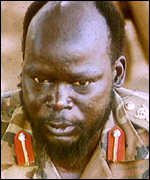
27: SPLA
leader Dr John Garang was challenged to participate directly in talks between
Khartoum and the rebel group. The Sudanese Minister for Animal Resources Dr
Riek Gai Kok, said that Garang was "the key to ending the conflict in the
Sudan and he should take direct responsibility".
27:
US Treasury Secretary Paul O'Neill reiterated the Bush
administration's opposition to legislation that would bar oil companies
operating in Sudan from raising money on US
capital markets. "No one finds the events in Sudan more
reprehensible than we do," O'Neill told members of the House International
Relations Committee. "The reason I don't think (the legislation) is a good
idea is that it sets a precedent," O'Neill said, adding that it would be
dangerous for Congress to interfere with capital markets.
29:
Sudan said 29 abducted Sudanese have been freed and sent to
their homes in the civil war-ravaged southern part. Arab tribesmen had abducted
the 29, all women and children, in southern Darfur state, western Sudan,, said
the Sudanese Commission for the Eradication of Abduction of Women and Children.
29: Malaysia's
state-owned Petronas, one of Talisman Energy Inc.'s joint venture partners in
Sudan, said it does not want to buy the Calgary company's stake in the oil
project. "We aren't interested in buying Talisman's stake in Sudan,
although we hope to expand our acreage and increase production there,"
said Petronas chairman Hassan Marican. Petronas, along with state-owned China
National Petroleum Corporation, another joint venture partner, have rights of
first refusal to Talisman's 25-per-cent stake in the venture.
30:
Government troops have recaptured the town of Gogrial in
southern Sudan after two months of fighting with the SPLA, the army said. Armed
forces spokesman General Mohamed Bashir Suleiman, in a statement on state-run Omdurman radio, said troops backed by
militiamen and mujahedeen volunteer Muslim fighters seized the town. The radio
said the town in north Bahr el-Ghazal state had been under SPLA control for
more than two years.
30:
President Bashir urged the SPLA to work with the government
to forge a peace deal based on equal rights for all and respect for different
religions in the war-torn country. In a speech marking the 13th anniversary of
a coup that brought him to power, Bashir said he hoped ongoing peace
negotiations in Nairobi would help end the civil war.
July
1: Nine Sudanese civilians were killed and five seriously
wounded when Khartoum bombed a strategic town captured last month by the SPLA,
an aid agency official said. "At 10 a.m. (0700 GMT) the government of
Sudan bombed Kapoeta," Dan Eiffe, liaison officer at Norwegian People's
Aid (NPA), told Reuters in Nairobi.
"No SPLA (rebel Sudan People's Liberation Army) military personnel were
killed as they were said to be out of the town when the bombing happened. It
was carried out by one Antonov plane," he said.
1:
Negotiators in peace talks to end the 19-year civil war in
Sudan face critical decisions in coming weeks, but a senior US official
expressed confidence that the latest "reinvigorated" round is off to
a good start. Walter Kansteiner, Assistant Secretary of State for Africa, said
"some tough specifics" like the nature of self-determination for
southern Sudan and a potential transitional government were "a week or so
away," after the talks opened June 17 in Machakos outside Nairobi.
"Some good stuff has happened; there's actually rapport being built
between the two negotiating parties," Kansteiner said after meeting SPLA
leader, John Garang and Kenyan President Daniel arap Moi.
2:
Sudan has extended for one month an agreement that allows
the delivery of UN relief assistance to victims of its 19-year-old civil war in
southern Sudan, the independent al-Ayam
newspaper reported. The United Nations seeks the consent of the government and
the SPLA on a monthly basis for the running of Operation Lifeline Sudan, a
programme to deliver humanitarian assistance to both government and rebel-held
areas in southern Sudan.
2:
President Bashir said his army have joined Uganda's forces
in the fight against a Ugandan rebel group based in southern Sudan. In an
address on state-television, Bashir said Khartoum was planning and supervising
joint-military operations with Uganda against the Lord's Resistance Army (LRA).
Analysts said the comments were the first time Sudan had announced it was
fighting alongside Ugandans to expel the LRA, although Khartoum had in March
allowed Ugandan forces onto its territory to destroy LRA bases.
2:
Defence lawyers representing Sudanese opposition leader
Hassan Turabi filed a lawsuit seeking his release from house arrest, Sudan's
Constitutional Court said. Judge Ali Yehia Abdullah said that the court
received the request, but hadn't made a decision or set a hearing date yet.
Turabi, aged in his 70s, has been under house arrest in Khartoum since early
2001, when he forged a political alliance with the SPLA.
2:
A senior US State Department official held talks with
President Bashir and said the Bush administration was "encouraged" by
efforts by Sudan and rebel groups to end their civil war. "The willingness
of both parties to reach peace has encouraged the administration to carry on
with its efforts towards reaching peace in Sudan," Assistant Secretary of
State for African Affairs Walter Kansteiner told journalists after their
meeting in Khartoum.
2:
US Secretary of State Colin Powell said that, despite
progress toward peace in the south, Sudan has "a way to go" before
Washington removes it from its list of "state sponsors of terrorism".
Powell was speaking in an interview with CNN
after talks in Khartoum between President Bashir and US Assistant Secretary
of State Walter Kansteiner.
2:
India is making a "fateful mistake" by investing
in oil in Sudan, warned the SPLA. Last month, the Indian Cabinet voted for the
state-run Oil and Natural Gas Corporation
(ONGC) to invest $750 million in the controversial Sudanese oil project.
"No company should get involved in exploration or exploitation of oil in
Sudan during this time of war, whether it is Indian, Canadian or Chinese,” said
SPLA spokesperson Samson Kwaje.
2: A
settlement to the Sudanese civil is
unlikely to be achieved any time soon unless the US and Europe exert much
stronger pressure urgently, according to a new report by an international think
tank that specializes in conflict resolution. In particular, the Brussels-based
International Crisis Group (ICG) is calling on the US Congress to enact the
long-pending Sudan Peace Act that includes penalties against foreign oil
companies that invest in Sudan's booming but increasingly bloody oil sector.
4:
A Sudan Airways cargo plane smashed into a residential
district of the Central African Republic capital of Bangui killing around 20
people, witnesses said. The plane had been heading to Congo Republic but made a
detour to Bangui because of technical problems and crashed short of the main
airport, a source at regional air authority Asecna (Agency for the Safety of
Air Navigation in Africa) said.
5:
The SPLA agreed
to an extension of a government ceasefire offer in the Nuba Mountains. An
international committee overseeing a six-month renewable ceasefire between
Khartoum and the Sudan People's Liberation Army (SPLA) came into effect in
Sudan's Nuba Mountain region in January. The ceasefire's first mandate period
will end on July 19, 2002.
6:
The head of Sudan's largest northern opposition party
declared that he would not enter any separate power sharing arrangement with
the government. "We will participate only in a national government or a
freely and fairly elected one," UMMA chairman Sadeq al-Mahdi told
reporters at a press conference, where he announced the creation of an
eight-member committee, under his leadership, to negotiate with the government.
Mahdi's statement comes as an implicit rejection of recent negotiations by his
cousin, Mubarak al-Fadil al-Mahdi, reportedly aimed at the party's entry into
the government.
6:
Sudan's army has denied reports that it bombed civilians in
Kapoeta, the official SUNA news agency reported. Southern Sudanese Catholic
church officials claimed that a government Antonov had bombed the town of
Kapoeta killing five and injuring seven. The SPLA confirmed the bombing.
7:
A team of US military experts has conducted a technical survey
of landmines in different locations in the Nuba Mountains, a Sudanese
independent newspaper said. The team, made up of serving US army officers, will
prepare and submit to the Sudanese government a report on landmines in the
region, local humanitarian aid official Ibrahim Abdel Qadir was quoted by al-Hurriya daily as saying.
8:
Britain's special envoy for Sudan has arrived in Khartoum
for talks with the government on ending the country's 19-year-old civil war, a
senior Sudanese official said. Presidential peace advisor Ghazi Salah Eddin
said that Alan Goulty had brought no specific initiative or proposal, but
rather intended to acquaint himself with the government's position.
8:
The World
Council of Churches (WCC) General Secretary Rev. Dr. Konrad Raiser told the
Sudanese government to end their policy of political exclusion and social
injustice. He described the country’s civil war as a deceptive facade used by
Khartoum's government while they actively engaged in exacerbating all kinds of
inequalities.
9:
More than 150 LRA rebels attacked a refugee camp in northern
Uganda, killing six people, including three women and a child, the UN refugee
agency said. The rebels attacked Maaji camp, which is home to thousands of
Sudanese looting and burning homes, a school and a dispensary, the UN High
Commissioner for Refugees said in a statement. They also attacked an Ugandan
army post in the camp killing one soldier.
10:
A splinter of the Sudanese opposition UMMA party said it
will replace party chairman Sadiq el-Mahdi and consider joining the government.
The faction, headed by Mubarak el-Mahdi, Sadiq el-Mahdi's cousin, held a
conference to discuss its possible participation in the government and said it
will elect a new chairman. Spokesman Ibrahim el-Zahawai said the time has come
to embark on the process of reforming and modernizing the party, and accused
Umma leaders of failing to represent "the party's conscience" and
isolating it from its members.
10:
UN Secretary-General Kofi Annan began a trip to Sudan with a
call for humanitarian access to Sudanese caught up in the conflict. The UN
needs approval from the government and the rebel SPLA on a monthly basis to
deliver humanitarian aid to areas held by both sides in the south of the
country. "We are always concerned and extremely disturbed when we do not
have free and unfettered access to those in need," Annan told reporters on
arrival at Khartoum airport.
11:
Austrian oil and gas group OMV said it was awaiting the
results of a independent study of the human rights situation in potentially
oil-rich areas of Sudan. OMV is part of a consortium of oil companies led by
Swedish oil explorer Lundin Petroleum and including Malaysia's Petronas and
Sudan's Sudapet, exploring in Sudan's block 5A. OMV suspended its activities in Sudan in January 2002 after
violence escalated and has said it needed assurances that reports the
government was using violence to depopulate villages in block 5A in Western
Upper Nile and other areas were not true.
11:
The head of the International Commission to monitor the
agreement signed by the Sudanese government and the SPLA to protect civilians
in war zones, arrived to begin his work. Herbert Lloyd, a retired US army
general, told reporters he would be heading a team of 20 former soldiers whose
duty would be to verify the agreement to protect civilians in the war-ravaged
southern Sudan. The team will be split into two. 10 of them would be stationed
in Khartoum while the other 10 would be deployed in the rebel- controlled
Rumbek town in the south.
12:
The UN and Sudan have agreed to resume humanitarian aid
assistance to war-torn southern Sudanese provinces, UN Secretary-General Kofi
Annan and Sudanese officials said. In a news conference following talks
Thursday with President Bashir, Annan said humanitarian workers will be allowed
into all but 18 locations in the country's south.
12:
A breakaway faction of Sudan's opposition UMMA party said it
had replaced Sadiq el-Mahdi, the party's leader, with his cousin and that it
planned to join President Bashir's government. In a statement, issued at the
end of a three-day conference, the group said Mubarak el-Fadel el-Mahdi was
named party chairman and that it has dismissed the party's political and
executive committees. Ibrahim el-Zahawi, a spokesman for the breakaway faction,
said: "We have decided to join the government in accordance with a program
approved by the conference."
12:
Swedish oil exploration company Lundin Petroleum said any
peace agreement in Sudan would not alter its decision to suspend drilling
operations there until the end of this year at the earliest. Lundin said
drilling could in any case not resume until December when the dry season
begins.
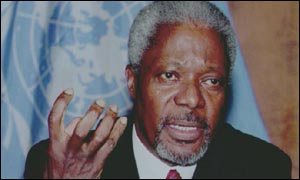
12: UN
Secretary General Kofi Annan said yesterday that a peace deal between the
Sudanese government and the SPLA was likely by the end of next week, given the
pace of talks, which started last month in neighbouring Kenya. "Peace is
coming soon," Annan said during a three-day visit to Sudan. "I expect
an agreement will be reached for ending the war before July 20."
14:
The SPLA said it captured a strategic crossroads in the
country's war-torn south destroying two Sudanese army formations. "Our
forces in a sudden attack ... today captured the strategic Lafon outpost,
aborting government preparations to gather its forces in Lafon and launch an
attack on the (rebel-held) town of Kapoeta," a faxed statement received by
AFP said. Lafon lies at a strategic crossroads connecting Juba, the main
government garrison in the south, with roads running north to Bor and east
towards the garrison town of Torit, the statement said.
2. Government
extends oil pipeline to Port Sudan, reluctant to extend water pipes to the
seaport
By Dominic Ladu Hussein
One of Sudan’s important cities, Port
Sudan lacks adequate water for its residents. And whatever water is available
is only for the rich, residents told AFRICANEWS.
“Port Sudan has been known as an international port that handles
both imports and exports. All the governments since independence paid little
attention
to the problem of drinking water in Port Sudan,” says Albert Ohide, a resident.
The problem of drinking water or lack of clean drinking water in the town usually occurs during the months of July and August, which are hottest months in the country. “These are dangerous months for Port Sudan citizens,” said Ohide. A religious worker who declined to be named, concurs by stripping and showing his back covered with tiny swellings due to too much heat and lack of water for drinking and for taking bath. He said a barrel of water now costs one US dollar.
“But the majority of the people are poor. Most of them earn less than fifty dollars a month. If they spend four dollars a day, in a month they will have spent about 120 US dollars for water alone. That means they will always live beyond their financial capacities,” said the worker.
By the time we went to press, at least three people are reported to have died due to the rising temperatures in the town. Port Sudan’s State Health Minister, Dr. Mohammed Ahmed Abdul Hafez, who ironically lamented, “this year’s heat stroke casualties are less compared to last year’s”, confirmed the deaths. The most affected are the labourers and street vendors.
Located about 1,000 km north east of Khartoum, Port Sudan Sudan’s only seaport with Juba and Kosti as harbours along the Nile River. It boats of a population of more than a million people, plus another half a million internally displaced people residing there having fled various parts of the war-torn southern Sudan. With its location in northern Sudan, it is not uncommon for temperatures to reach as high as 42 degrees centigrade.
Water for the port comes from streams south of the city, but the amounts are insufficient. Matters have been made worse by poor infrastructure, which has translated, to thousands of residents having no access to the precious liquid.
The water is collected during the rainy season and stored in a reservoir before being supplied to the people for sale by tankers. For the reservoir to be filled, it must have rained nine times the previous rainy season. But last year, it rained only twice, less seven rains. “The reservoir is now empty. Many people have resorted to drinking and bathing using the salty Red Sea water,” said one worker.
But what galls the residents is the fact that the government has been able to extend oil pipes right from southern Sudan, some one thousand five hundred kilometres, up to Port Sudan but has failed to extend water pipes from the Nile to the seaport. “The Nile water is nearer to Port Sudan than the crude oil,” observes Ohide.
Ends
Part II- Northern Uganda
1. Briefs
June 15: The military offensive by
the Ugandan army against the rebel Lord's Resistance Army (LRA) in southern
Sudan is forcing its leader, Joseph Kony, to release and allow his
non-combatant captives to return to northern Uganda, a senior army official
told IRIN. According to Maj. Shaban
Bantariza, the director of information in the country’s Uganda People's Defence
Forces (UPDF), the pressure of the offensive was forcing Kony to "get rid
of his excess baggage", mainly comprising young children and weaker women.
19: The government of Uganda
and the rebel Uganda National Rescue Front (UNRF-II) signed a formal ceasefire
agreement in Yumbe District, northwestern Uganda, with the aim of paving the
way for political dialogue in the West Nile region. Minister for Internal
Affairs Eriya Kategaya, for the government, and the UNRF-II chairman, Maj-Gen
Ali Bamuze, signed the peace agreement in which the parties said they would
"mutually and unequivocally" to stop all forms of hostility and
belligerence. The agreement followed dialogue between the two sides since 1998
and the announcement in January 2001 of a general amnesty for those rebels who
renounced rebellion and surrendered to the Ugandan authorities.
26: A new
spate of attacks over the past week by the LRA in northern Uganda on villages,
burning huts and abducting people, is producing a new wave of internal
displacement and putting a strain on ongoing relief and development work in the
region, according humanitarian sources. A humanitarian worker based in the
northern town of Gulu told IRIN that "virtually all" NGOs had halted
their operations in northern Uganda due to the rise in insecurity. According to
this source, all roads linking the northern districts of Gulu, Kitgum, Pader,
Lira and Pakwac have become unsafe due to increased rebel activity in the area.
July 3: Twenty-five
civil society organisations in Uganda announced the formation of a new
coalition aimed at ending insecurity in northern Uganda. The Coalition of Civil
Society Organisations for Peace in Northern Uganda (CSOPNU), as it is known,
was formed after members met to express growing concern over the escalating
"cycle of violence" in the north. In a statement, the coalition said
its mandate was to stimulate debate on some of the causes of the long-running
conflict in the north and search for solutions.
5: Calm is
steadily returning to northern Uganda where LRA rebels have in recent weeks,
stepped up attacks on villages, army spokesman Major Shaban Bantariza told
IRIN. "For the past four to five days, the mayhem has gone almost to zero.
We have now deployed our mobile forces to track them down individually,"
Bantariza said. He said the attacks - which constitute violence, abductions and
the torching of huts, shops and vehicles in parts of northern Uganda - was the
LRA's way of causing "mayhem" and creating a "climate of
crisis" in the region.
8: The UN's
World Food Programme (WFP) has said that food security prospects in northern
Uganda for this year remain unstable due to continued attacks by LRA rebels.
"The
ongoing brutal attacks by the Lord’s Resistance Army rebels have grounded all
economic activities in outlying areas in the Gulu, Kitgum and Pader
districts," Edward Kallon, Deputy Country Director for WFP in Uganda, told
IRIN. "The residents in outlying areas and IDPs [internally displaced
persons] in protected camps in the three districts have very limited or no
access to their gardens. People are currently abandoning their homes for big
displacement camps or nearby towns," he said.
9: The
Ugandan army denied it was "running away" from rebel attacks in the
north of the country. Army spokesman Major Shaban Bantariza told IRIN the army
was still in charge in northern Uganda, where LRA rebels have stepped up
attacks on villages and camps for internally displaced people (IDPs). "If
we were running away from the camps, thousands of displaced people would have
been kidnapped already and there would be no camps," he said. "The
rebels would have burnt them all," he said.
10: LRA rebels attacked a refugee settlement in north-western Uganda,
killing five refugees and a government soldier, the UN refugee agency reported.
"According to available details, a group of LRA rebels, numbering 150 to
200, raided sites 9 and 11 of the Maaji Settlement [in Adjumani
District]," UNHCR said in a statement. During the attack on the two camps,
the rebels also burned down some 127 houses, five classrooms in a refugee
school, and looted the dispensary, UNHCR added.
12:
President Yoweri
Museveni has agreed to talks with the LRA rebels, but stressed his government
was keen to continue to pursue the group and root it out of its bases in
southern Sudan, the Ugandan media reported. "I have authorised bishops to
talk to them, but in the meantime, I will pursue them," the
government-owned 'New Vision' newspaper quoted Museveni as saying.
2. Rebels set northern Uganda ablaze as Museveni refuses to negotiate
By Linda Frommer
The Ugandan army's Operation Iron Fist
into southern Sudan to eliminate the rebel child soldiers of the Joseph Kony's
Lord's Resistance Army (LRA) has produced a ferocious escalation of the war by
the LRA into northern Uganda.
The attacks are concentrated on parish
missions and the so-called protected villages, where half a million Acholi
people of northern Uganda have been forced to live by the Ugandan government.
In the latest attack, on July 8, the LRA burned 312 huts in the protected
villages of Wiyanono and Pagak in Gulu district of northern Uganda and killed
four soldiers. Another group of seven rebels abducted two local officials and
11 children from Aswa County.
Earlier, on July 1, the rebels struck
the Purongo camp, setting huts afire and
abducting 11 people. And the week before, 16 rebels, soldiers, and
civilians were killed when the LRA
struck the town of Patongo in Pader District. In the same district on June 25,
the rebels struck a village burning down 45 shops and abducting 45 people. Days before we went to press, an LRA ambush
killed a major of the army and three of
his escorts in Pader district.
Against such, observers are asking:
Where is the UPDF? It is a question heard throughout northern Uganda. The level
of insecurity in northern Uganda is now at its highest since the war between
the LRA and the Ugandan government of President Museveni began in 1988.
According to local leaders, at nightfall local residents leave their homes
hoping to find some kind of protection, and often soldiers of the UPDF leave
with them. As one leader put it, "The UPDF went into Sudan to hunt for
Kony, but the rebels crossed into Uganda. So the UPDF have replaced the
LRA in Sudan and the LRA have replaced
them in Gulu, Kitgum, and Pader districts."
This is the precise outcome of an operation that Acholi leaders
who have been trying to bring about negotiations to bring the LRA out of the bush had predicted. But
that is not how Museveni’s military mandarins in Kampala saw the operation when
it kicked off in March with the permission of the Sudan government, which had
formerly supplied the LRA beginning in 1994.
In the first phase of the operation,
which was slated to last only six weeks, the heavily equipped UPDF soldiers
engaged in some battles with the LRA, which caused heavy damage to civilians in
the area of southern Sudan. Then the UPDF reportedly diverted its operation to
aid the Sudan Peoples Liberation Army (SPLA) in its taking of Kapoeta, a key
town in southern Sudan. This raises the obvious question: Was this the real
intent of Operation Iron Fist?
UPDF military operations had the approval of US Ambassador to
Uganda Martin Brennan, who won
"approval with conditions" for it from Washington. Reportedly, events have discredited the
military operation among high-level
officials in the US State Department.
Meanwhile, in northern Uganda, the situation continues to worsen.
All roads linking the northern
districts have become unsafe and are effectively shut down due to the rebel activity. The World Food Programme
reported July 8 that food relief
operations of WFP and other NGOs to the northern districts have been virtually shut down by the LRA attacks of the
last three weeks. At the same time,
residents are leaving their gardens at home and fleeing to the IDP camps. This
is no solution as Kony vowed in a letter sent to a local official that he would
continue attacking the camps.
It is against such background that the Acholi
Parliamentary Group has called on the Museveni government to declare the three
northern districts a disaster area. "Acholiland should be declared a
disaster area and there should be a massive humanitarian intervention to
provide the necessities of life to the displaced people," said the Acholi
MPs' statement. "We appeal to the Government and humanitarian agencies
like Red Cross, UNHCR, WFP, UNICEF to come to the aid of the people." The
legislators point that the operation has utterly failed not only to arrest
Kony, but also protect civilians of northern Uganda.
But these legislators are not alone.
One July 3, the parliament called upon President Museveni-who has personally
rejected a non-military solution to the LRA-to forgive Kony for the sake of the
people in the north. A week later, Roman Catholic Archbishop John Baptist Odama
and former Anglican Bishop Macleord
Ochola met with President Museveni and urged him to declare an
amnesty, guarantee the safety of
returning rebels, and seek a non-violent end to the war. But so far nothing
has come out of these appeals and the LRA, which has no political programme and
does not seek political power remains unscathed.
With time seeming not to be on
Museveni's side, now could be the time his government ceased any pretence of
protecting its territory or people, it must seek negotiations to end the war in
northern Uganda.
ENDS
Part III-
Horn of Africa briefs
June 17: Col Abdirazzaq Isaq Bihi, the Somali faction leader who was captured in the border town of Bulo Hawa, southwestern Somalia, has been released, local sources across the border in northeastern Kenya told IRIN. Bihi was captured by forces loyal to the pro-Ethiopian Somali Reconciliation and Restoration Council (SRRC) when they overran Bulo Hawa on 15 May. The SRRC is a grouping of southern factions opposed to the Mogadishu-based Transitional National Government (TNG). Bihi was brought to the Kenyan border town of Mandera where he was handed over to local elders. A Somali elder said that the Kenyan authorities in Mandera had participated in facilitating Bihi's release.
17: Ethiopia is determined to strengthen its ties with the Arab world, the government said. A statement issued by the information ministry said there were numerous economic opportunities that could be exploited by investors and the governments of Ethiopia and the Arab world. “These relations are no doubt essential to promote our national interest of peace, democratisation and rapid sustainable development,” the statement said.
18: Twenty people were killed in inter-clan fighting in the Middle
Shabelle Region of south-central Somalia, sources in the regional capital
Jowhar told IRIN. The fighting broke
out after forces of the self-styled governor of Middle Shabelle, Muhammad Umar
Habeb, who belongs to the Warsangeli sub-clan, attacked positions of forces
loyal to Dahir Dayah, the interior minister of the Transitional National
Government (TNG). The minister is a member of the Agon Yar sub-clan, which like
the Warsengeli, belongs to the main Abgal clan that dominates the Middle
Shabelle region.
19: The United Nations Security
Council expressed deep concern over the humanitarian situation in Somalia
following fighting in the south of the country. In a press statement, the
Council called on all Somali parties to fulfil their obligation to guarantee
safe access to relief agencies and their personnel. The Council made the call
after a briefing on the humanitarian situation in Somalia by the UN's Deputy
Emergency Relief Coordinator, Carolyn McAskie. The Council’s statement noted
that members were particularly worried about the situation in northern parts of
the Gedo Region, southwestern Somalia.
24: At a press
conference in Addis Ababa on Monday Ethiopian Foreign Minister Seyoum Mesfin
and his Iranian counterpart, Kamal Kharrazi pledged to cooperate in trying and
achieve peace in war-ravaged Somalia and southern Sudan. Both said peace in the
two countries was vital to ensure stability in the Horn of Africa. Ethiopian
Foreign Minister Seyoum Mesfin said Ethiopia and Iran were committed to
"cooperate and consult" to bring about stability in the region.
24: Relations between
Djibouti and the self- declared independent state of Somaliland, northwestern
Somalia, are set to improve following a three-day visit to Djibouti by the
Somaliland interim president, Dahir Riyale Kahin, a Djibouti official told IRIN
on Monday. The official said the two sides had reached agreement to iron out
any differences between "the two brotherly peoples". The provisions
of the agreement include ending hostile propaganda by both sides, reopening the
common border and "allowing traders from both sides to freely conduct
their businesses", according to the official.
24: The
Transitional National Government (TNG) in Somalia will attend the proposed
Nairobi Somali reconciliation conference, to be held under the auspices of the
regional Inter-Governmental Authority on Development (IGAD), a senior TNG
official told IRIN on Monday. Abdirahman Ibbi, the TNG's Minister of
Information, denied reports that the TNG was reluctant to participate in the
conference. "We are ready to attend the conference whenever and wherever
it is held," he said.
25: Ethiopia
backed the Arab League in its move to attend the forthcoming Somali peace
talks. Ethiopian Foreign Minister Seyoum Mesfin expressed support for the
League's wish to participate in the reconciliation conference, due to be held
in the Kenyan capital, Nairobi. This transpired after Amr Musa, Secretary-
General of the Arab League, called on Somali warlords to lay down their weapons
and fight for peace during a one-day visit to Ethiopia. "The well-being
and stability of the Horn of Africa is an important element in the stability
and security of the rest of Africa and the Middle East, and the Arab world in
particular," Musa told a press conference in the Ethiopian capital, Addis
Ababa.
26: The Oromo
Liberation Front (OLF) has claimed responsibility for a bomb blast in the
eastern Ethiopian town of Dire Dawa, an OLF spokesman told IRIN. The small bomb
had exploded in a building in the town belonging to the Ethiopia-Djibouti
railway, AFP reported on Tuesday. Quoting the national radio, AFP said the
building had been slightly damaged, but there were no injuries.
26: The office
of the United Nations High Commissioner for Refugees (UNHCR) has transferred up
to 1,043 Somali refugees, who have been stranded for weeks in the northeastern
Kenyan border town of Mandera, to the Dadaab refugee camp 500 km to the south.
The refugees are part of a group of 10,000 who fled inter-clan fighting in the
Somali town of Bulo Hawa near the border with Kenya starting in April, and have
been camped in and around Mandera under difficult conditions.
July 1: Ethiopia
and Eritrea are to meet at a key summit which should “set the pace” for the
peace process, the United Nations said. The two countries, which fought a
bitter two-year war, are due to meet in The Hague later this month where the
crucial border ruling over their disputed boundary was first announced. The
conference at the Ethio-Eritrea Boundary Commission (EEBC) will aim to thrash
out the complex physical demarcation of the 1,000-kilometre border. It is the
second time Ethiopia and Eritrea have met in The Hague since the border
decision was announced on 13 April.
1: The
Transitional National Government (TNG) of Somalia has called for the deployment
of foreign troops to disarm and demobilise armed militias, TNG Information
Minister Abdirahman Ibbi told IRIN. The decision to call for foreign troops was
reached by the Council of Ministers, and was ratified by the Transitional
National Assembly (TNA), he said. "Somalia is asking for the same kind of
assistance, in both military and financial terms, that countries with similar
problems, such as Sierra Leone and Bosnia, received from the international
community."
1: Fighting
broke out in the town of Baidoa between different members of the Rahanweyn
Resistance Army (RRA), which controls the area, local sources told IRIN.
Tension has been rising in the town as a result of a deepening split within the
senior ranks of the RRA, which controls much of the Bay and Bakol regions of
southwestern Somalia. The split originates from differences between the RRA
chairman, Hasan Muhammad Nur Shatigadud, and his two deputies, Shaykh Adan
Madobe and Muhammad Ibrahim Habsade, the sources said. The fighting started
when forces loyal to Shaykh Adan and Habsade tried to forcibly take possession
of the main police station, which is also the customs compound where taxes and
customs duties are collected, from Shatigadud loyalists.
2: UN
Secretary-General Kofi Annan has urged the various sides in Somalia not to let
their differences prevent the attainment of a peace settlement. In a report to
the Security Council, he noted that the regional peace effort for Somalia was
currently at an impasse because of differences on how to proceed with national
reconciliation. "Such differences will only complicate the already
difficult task of peacemaking," Annan said in his report.
4: Fresh
fighting erupted in the town of Baidoa in which at least 20 people were killed,
local sources told IRIN. The fighting between two factions of the Rahanweyn
Resistance Army (RRA), which controls much of the Bay and Bakol regions of
southwestern Somalia.
4: The
Ethiopian government claims it has crushed Oromo rebels "trying to launch
a guerrilla war" in the west of the country, allegations rejected by the
rebels as "false propaganda". In a statement, the Ethiopian
information ministry said a battalion of the rebel Oromo Liberation Front (OLF)
was wiped out around Dembi Dolo, near Gambela, with the help of area residents
and militias.
5: The rebel
Oromo Liberation Front (OLF) denied claims by the Ethiopian army that it had
"completely annihilated" separatist forces in the west of the
country. "This is not the first time the Ethiopians have claimed total
victory against our forces," OLF spokesman Lencho Bati told IRIN.
"Our forces are intact." He admitted that OLF troops had sustained
casualties in the fighting which has been raging in the Gambela region for the
past two months when the OLF launched an offensive in the area.
8: After days
of heavy fighting, a ceasefire was announced in the southern town of
Baidoa appears to be holding with no
violations reported, local sources told IRIN. A mediation committee led by a
prominent businessman, Ali Margus, and former minister, Ambassador Sharif
Salah, who is an influential Rahanweyn personality, reportedly arranged the
ceasefire.
10: The UN Security Council confirmed that the planned Somali peace
talks to be held under the auspices of the Intergovernmental Authority on
Development (IGAD) in the Kenyan capital, Nairobi, are now scheduled to take
place in September. The Council's current president, Ambassador Jeremy
Greenstock of the United Kingdom, said the Council, which is to consider a
draft resolution on Somalia this week, "has discussed the prospects of the
conference in Nairobi".
10: The warring sides in the
southern town of Baidoa have officially signed a ceasefire document, local
sources told IRIN. They said both sides have observed the ceasefire, which was
arranged by a mediation committee and announced over the weekend,, even before
it was officially signed.
15: Tension is rising in the disputed Sool region of the self-declared
republic of Somaliland as forces of Somaliland and those of the self-declared
autonomous region of Puntland deploy in the area, a local journalist told IRIN.
Abdinasir Mire Adan of the Bosaso-based Radio Midnimo (Puntland) said the
Somaliland authorities had deployed a force of 450 men at the village of
Yagori, some 60km north of the Sool regional capital, Las Anood.The region which
falls geographically within the borders of the former British Somaliland, but
where most of the clans are associated with Puntland, is claimed by both
Puntland and Somaliland.
Ends