AFRICANEWS-Sudan
A monthly publication of
AFRICANEWS
For the period covering August
15 – September 15, 2002
Contents:
Part I – Sudan
1. The fall of
Machakos, according to the GoS
2. Chronology
Part II- Northern Uganda
briefs
Part III- Horn of Africa briefs
Part 1 – Sudan
1. The fall of
Machakos, according to the GoS
On September 2, negotiations within Machakos II – the follow-up to the historic Machakos Protocol that was signed by the Government of Sudan and the Sudan Peoples’ Liberation Army/Movement (SPLA/M) on July 20 in the town of Machakos, Kenya – abruptly halted following the withdrawal of the Sudan government from the table. One of the reasons that the government gave for pulling out was the insistence by the rebels that three areas in northern Sudan – the Nuba Mountains, Abyei, and southern Blue Nile – be annexed to the rest of southern Sudan. Khartoum refused this, saying that the SPLA has to stick to the 1956 borders that placed the three areas in the north. The significance of the three areas is that non-Arab, non-Muslim people who have more in common with southern Sudan, largely inhabit these areas.
Africanews-Sudan has asked Dirdeiry Ahmed, Charge
D’affairs, Embassy of Sudan in Nairobi, Kenya, to give his analysis of why
the government has pulled out of the Machakos II talks.
Q: Were you yourself present during the first and
second rounds of Machakos?
A: Yes.
Q: How was it that the issue of the annexation of the
Nuba Mountains and the southern Blue Nile to the south was not discussed in the
first round of negotiations?
A: The Nuba Mountains is not part of
southern Sudan. That has been the situation since the presence of the colonial
master. Secondly, the Nuba Mountains is predominantly Muslim, and southern
Sudan is predominantly Christian…The issue of the relation between the state
and religion, which is one of the major bones of contention in southern Sudan,
is not all relevant in relation to the Nuba Mountains. The issue of
self-determination is also not relevant.
The IGAD peace process on Sudan is not mandated to
discuss the Nuba Mountains… What happened, in fact, is that when the SPLA/M
signed the protocol and tried to sell it to its constituency, they faced the
problem: What about us? What about the Nuba Mountains? What about the southern
Blue Nile? I think they failed to find a convincing answer. This is the reason
why when they came back to Machakos II, they brought the SPLM leader of the
Nuba Mountains and the SPLM leader of the southern Blue Nile to the table as
delegates for the first time.
Q: Why do you suppose the people of the Nuba
Mountains and southern Blue Nile are pushing to be included in the south?
A: Those people who have joined the
SPLA/M from the Nuba Mountains… did so during the Cold War era. At that time,
the SPLA/M was portraying itself as a Communist movement. Some people who
believed in Communism slogans from those areas had joined the SPLA/M thinking
that they can, in fact, liberate all of the country from imperialism similar to
the way that maybe Guevara and Castro did. That was the original idea. Of
course, in time, the SPLA/M itself had changed… Now, it should be called
“southern” Sudan Peoples’ Liberation movement – it should be SSPLA/M, because
they are no longer speaking about all of the people of Sudan. So, those people
of the Nuba Mountains and southern Blue Nile who had joined the SPLA/M earlier
have been left in limbo because they are not right now fighting within a
movement that is having as its goal liberation of all of the country.
Q: Some people say that the Sudan government is
resisting the inclusion of the Nuba Mountains and the southern Blue Nile in the
south primarily because there is oil and other resources on that land. How do
you respond to that?
A: It is not only the Government of
Sudan that is resisting attaching those areas to southern Sudan. A very
considerable constituency in the south is against that, thinking that ‘if we’re
going to have those people included in the south, this would really affect the
final outcome of the referendum because those people are definitely not for
secession.’ The SPLA/M itself is on record as saying that those people are not
part of the south and even where, right now, they have reopened this issue,
they said not because those people are southerners, not because those areas are
part of the south, but because those people are fighting along with us…
They are not claiming that those places should be
part of the south proper but they think that those places could right now be
part of the southern region to start with and then a referendum should be
carried out in those areas for the people to decide whether they should be part
of the north or the south. For us, this is a non-issue simply because we have
to keep in mind that the SPLA/M in the Nuba Mountains and southern Blue are, in
fact, not representing the people in those areas. Throughout their history,
they continue to be very limited in number and controlling a very thin
territory [five percent] in those two areas... So, the government cannot make a
deal with those five percent of the people and impose it on the other 95
percent.
Q: Will there be any circumstances in future
negotiations under which you would be willing or able to negotiate the
annexation of Nuba Mountains and southern Blue Nile joining the south?
A: This is out of the question. We
cannot accept that. Southern Sudan is having borders that have been demarcated
since colonial times. All of us accept the borders that have been left by the
British. We don’t feel that it would be proper to reopen this issue. We are
going to address the main issues of the people over there – problems of
underdevelopment, problems of self-administration, and so on. But we are not
going to reconsider the issue of annexing them to the south.
Q: In your mind, what was the key factor to end this
latest round of negotiations?
A: The fact that the SPLA/M had
backtracked on so many (points) made in the Machakos Protocol… The structure of
government that has been envisaged in the Machakos Protocol is a sort of structure
that divides all of the country into states – states in the north and states in
the south… And then we would have a regional government for the south…The
SPLA/M has re-opened that issue and has proposed only two states in the country
– one is set in the north, and one is set in the south… They have referred to a
“union” government rather than a “national” government, and that union
government should be having very limited powers. The supreme power that we had
spoken about to be left with the national government will be going practically
to the states. That was a major deviation.
The second one was about the issue of state and religion. That issue had been completely concluded in the Machakos Protocol. We had agreed that the northern part of the country should be governed by Sharia whereas the southern part should not… They had revisited it indirectly by saying that we want a Sharia-free capital [Khartoum]… Even if the capital is going to be in the south and not in the north, it couldn’t be a Sharia-free capital because it had been agreed that national legislation should be informed by Sharia, whether this national legislation is issued from Khartoum or from Nuba… We had decided already that all the south should be a non-Sharia zone and all the north should be a Sharia zone.
The third issue was that they had re-opened… [the
issue of] trying to annex those two areas [Nuba Mountains, southern Blue Nile]
plus Abyei. The re-visiting of this issue is completely unacceptable because it
can open a Pandora’s Box.
Another concern was the issue of cessation of
hostilities. There was an appeal that was issued by [Kenyan] President Moi in
May addressed to the parties asking them to consider the idea of having
cessation of hostilities during the negotiations. We had responded positively…
whereas the SPLA/M refused. We were all of the time saying that, once there is
no cessation of hostilities, negotiations would be undermined. This, in fact,
had materialized when the SPLA/M had taken Torit. Definitely, that has spoiled
the negotiations… They [northern delegation members] were under tremendous
pressure from [their] constituency not to continue negotiations. People were
feeling that they have been betrayed.
Q: What are the conditions that you would need to see
to come back to the negotiating table?
A: We cannot proceed and think that
we can make peace if we are fighting. We have to stop fighting first… We feel
that the commitment of the parties to the Machakos Protocol is a must… We have
to respect it. We have to go along the lines that had been defined in that
agreement. The Secretariat should be very tough on any party who wants to come
up with positions that don’t tarry with the Machakos Protocol.
Q: You talk about peace, yet there is a jihad [Holy
War] that has been declared against the Nuba Mountains and areas of the south.
How do people talk peace when there’s this jihad?
A: Of course, everyone knows that
nobody in the government was speaking about jihad since we have signed the
Machakos agreement. We think that the government will speak about jihad if
there is war. Definitely, if the other party is accepting to see a ceasefire
and a cessation of hostilities put in place, there will be no need to speak
about jihad… Right now, the call of jihad had been run rampant because the
SPLA/M had taken Torit.
Q: It sounds to me like jihad is
being used as a threat.
A: It’s not. The religious dimension
of the war had come to the limelight because of Sharia but also the issue of
secularism that has been the motto of the SPLM. Everybody in the north is
feeling that the SPLA/M is out to impose secularism down the throats of the
Muslim population. This is an offence against our religion. Secularism for
Muslims means non-religiosity. Because they don’t believe in that, they will
stand up and try to fight back. This is the general feeling. It’s a very
important factor of what’s happening. The value of the Machakos Protocol is
that it has neutralized the issue of religion. It reached a formula that was
acceptable to everybody.
Q: The people who you are negotiating with have had
some very bad experiences with the government in the past. How do you establish
trust amongst these people who are mistrustful?
A: The war has continued for a very
long time and everybody in Sudan is affected very much by this war... Don’t
forget that every family in the north had lost at least one of his children or
his parents to the war. Everybody is feeling that the country is devastated
because of the war… It is the responsibility of everybody to try to attend to
the very special, particular needs [of the victims of the war], but that cannot
be done by one party. All the parties should work together to do that.
What has been achieved in the Nuba Mountains is very
good. We have to build on that. This is the reason why we feel that the
ceasefire that has been there for some time could in fact be transferred to
other parts of the country. This will be the way to start a healing process for
all.
Q: Can you tell me about the role that the
international community has played in these negotiations?
A: Definitely it was great… But to
be very frank, we feel that the international community hadn’t achieved enough
when it comes to the issue of ceasefire… They [the international community] in
fact sympathized very much with the position of the SPLA/M. The SPLA/M is
insisting to fight. The SPLA/M in fact had made it a point that fighting should
not stop until a FINAL peace agreement is reached. This is very ridiculous.
[The international community] can really exert a lot
of pressure on them [SPLA/M] to accept the idea of cessation of hostilities.
This is the moment we need right now for the international community to
intervene. If the international community is going to intervene and just ask
the government to go back to the table for negotiations, period, otherwise
we’re going to do so and so, this will not be fair to the government and will
not be fair to the cause of peace itself.
Q: Are you under any kind of pressure from the
international community, especially the U.S., to get back to the table?
A: We’ve been under tremendous
pressure to get back to the negotiations, from all of the corners of the globe
thinking that this is the right thing to do. Of course, this is not correct. We
should, in fact, strike a reliable peace process.
The government of Sudan has been sanctioned since
1989 continuously – up to now we are under sanctions. Any reasonable person,
judging from the pervious experience, will come to the conclusion that such
sanctions are completely ineffective. It is always better to have a convinced
partner willingly coming to negotiate rather than somebody who has been brought
under pressure.
ENDS
2. Chronology
August 15, 2002: After a meeting with Arab League Secretary General Amr Musa
in Cairo, US special envoy to Sudan John Danforth said that peace in Sudan,
along with "cooperation with respect to anti-terrorism ... plus
humanitarian access [to conflict zones]" would bring progress towards
normalizing relations with the US. Washington is currently represented in Sudan
at the charge d'affaires level.
15: Egyptian
Foreign Minister Ahmed Maher said a lot of work remains to be done to ensure
that all Sudanese people would choose unity. "We agreed that it is
important for all of us to work together to help the Sudanese safeguard their
unity, because this is an important matter to the Sudanese people, to Africa
and Egypt," said Maher after meeting with John Danforth.
15: The
International Crisis Group released a report saying that, with its new oil reserves,
the government of Sudan has purchased MiG-29s from Russia and other advanced
weapons from Russia and China. The ICG predicted that the civil war in Sudan
would escalate, with Khartoum intending to exploit its increasing advantage in
air power.
15: Sudan's
ruling party, the National Congress (NC), has decided to change its slogan -
Jihad, Victory and Martyrdom - to something the rather more conciliatory. The
new slogan - Peace, Unity and Development - is meant to promote peace with the
largely Christian south, Ibrahim Ahmed Omar, the party’s secretary general,
told BBC.
16: Some
600 relatives of the September 11 attacks – calling themselves Families United
to Bankrupt Terrorism – filed a 15-count, US$100 trillion lawsuit against the
Sudanese government and Saudi officials, banks and charities, charging they
financed Osama bin Laden's network and the attacks on the US.
16: A
faction that has broken away from the opposition UMMA party will be given four
full portfolios and two state ministries in a cabinet reshuffle expected in a
few days. The UMMA dissidents will receive the education, information, tourism
and international cooperation portfolios, as well as state ministry offices in
the foreign and agriculture ministries, ruling NC Secretary General Ibrahim
Ahmed Omar was quoted as saying.
16: The
NC party denied reports that it had adopted a new slogan calling for
"peace" to replace an earlier one calling for "Jihad" (holy
war). A statement issued by NC denied a media report that the party had changed
its slogan from "Jihad, Victory, and Martyrdom “to” Peace, Unity,
Development." The party had no official slogan, the statement said, while
"Jihad, Victory, Martyrdom" is the slogan of Sudan's paramilitary
Popular Defence Forces, and has not been changed.
16: The
United Nations` High Commissioner for Refugees (UNHCR) announced that it was
moving more than 20,000 Sudanese refugees who survived an attack in early
August on the Achol Pii refugee camp, which held 24,000 Sudanese and displaced
Ugandans. More than 60 Sudanese refugees were killed in the attack, led by
Ugandan Lord's Resistance Army (LRA) rebels.
17: The
Sudanese government granted the Ugandan army a one-month extension to fight the
LRA rebels operating from bases in southern Sudan, said Ugandan military
sources. Uganda and Sudan signed a protocol in March allowing Kampala to deploy
troops in government-controlled areas of southern Sudan to flush out LRA
rebels.
17: President
Omar el-Bashir told a Sudanese daily newspaper that Sudan had "never relinquished"
the town of Halaib and surrounding areas – a mineral-rich Red Sea region along
the two countries' borders – to Egypt. The thorny issue of the Halaib triangle
was believed resolved in 2000, when Sudan withdrew troops from the area and the
Egyptian army took it over.
17: President
Bashir has said his government does not guarantee that the separation of
southern Sudan would not occur, Egypt's official MENA news agency reported.
"Sudan's unity cannot be imposed after years of war, and Egypt's fears
concerning the possible secession of southern Sudan have justifications,"
Bashir told the Sudanese press, according to MENA. Egypt claims that a
separated Sudan will undermine Egypt's security due to the possible sharing of
the water resources of the Nile.
17: The
Sudanese constitutional court has ordered the release of Islamist opposition
leader Hassan al-Turabi. The 71-year-old Turabi has been under house arrest
since last year and is being held in Khartoum's Kafouri suburb. Turabi, an
Islamist ideologue, and four colleagues of his opposition Popular National
Congress (PNC) were arrested in February 2001 on charges of trying to undermine
the constitution and of waging war against the state after signing an agreement
with the rebel Sudan Peoples Liberation Army (SPLA).
18: Sudanese
Foreign Minister Mustafa Ismail said that, in a letter to President Bashir, US
President George W. Bush had renewed his commitment to support peace efforts in
Sudan. The message said that the US administration was "committed to the
peace process in Sudan and will continue helping the Sudanese government to
reach (...) an end to the (19-year-old) war," said Ismail.
18: President
Bashir renewed the detention of Islamic theologian and opposition leader Hassan
Turabi for another year, one day after Turabi's party announced he would be
released soon. The official Sudan News Agency (SUNA) quoted Bashir as saying
that his decree was based on Article 132 of the constitution and Article 15 of
the Law on Emergency and Public Security of 1998.
18: In
response to a US$100 trillion lawsuit filed against the Sudan government and
others by families of September 11 2001 attacks, Khartoum dismissed allegations
that it had funded Osama bin Laden. The Saudi banks, Islamic charities, and
other named in the suit blasted the case as an attempt to extort Saudi wealth
abroad.
18: Eritrean
Foreign Minister Ali Said Abdellah said that Eritrea supports a comprehensive
political solution to the Sudan issue within the framework of Sudan's unity.
"Eritrea also understands Egypt's concern over the possible separation of
the south from Sudan," Abdellah said after his meeting with Egyptian
Assistant Foreign Minister Sami Yassin Abdel-Shaheed.
19: President
Bashir reshuffled his cabinet allowing members of a faction that split from a
key opposition party, UMMA, to join his government. Bashir appointed Mubarak
el-Fadel el-Mahdi as his assistant and Ali Hassan Taj Eddin as presidential
adviser for African affairs. El-Bashir also appointed four new ministers and
three state ministers, all members from Mubarak el-Mahdi's breakaway UMMA
faction. El-Zahawi Ibrahim Malik was appointed Information and Communications
Minister; Ahmed Babakr became Education Minister; Abdel-Jalil el-Basha took the
Minister of Tourism and National Heritage post, and Yusuf Suleiman became
International Cooperation Minister.
19: US
envoy, John Danforth, told a press conference in Nairobi that both the Khartoum
government and the SPLA have expressed commitment to the peace agreement when
he met leaders of the two sides on separate occasions recently. "I am
optimistic that a comprehensive peace deal could soon be reached to end Sudan's
19-year-old civil war,” Danforth said. But he warned that peace building is
hard work.
19: President
Bashir has thanked Ugandan President Yoweri Museveni over his role in bringing
peace to southern Sudan. The Council of Ministers of Sudan also thanked Kenyan
President Daniel Arap Moi, the presidents of the IGAD member states, and IGAD
partner forums and observers for their efforts to bring together the government
of Sudan and the SPLA.
20: The
SPLA, which controls much of southern Sudan, reached an agreement with the
Didinga people of the Equatoria region in the south to end their long-standing
bilateral conflict. In the declaration, signed on August 12 under the auspices
of the Kenya-based New Sudan Council of Churches (NSCC), the two parties
apologised to each other, pledged to unite and to work towards solving the many
problems affecting war-ravaged southern Sudan.
20: Ethiopian
Prime Minister Meles Zenawi met with Sudanese presidential special envoy Ghazi
Salah Eddin in Addis Ababa to discuss the ongoing peace process in Sudan. Meles
said that Ethiopia has a strong desire to see the successful completion of the
peace process between the Sudanese government and the SPLA: The success of
Sudan's peace process has a paramount importance for the prevalence of peace
and stability in the Horn of Africa, added Yenawi.
20: Ugandan
President Yoweri Museveni and US envoy John Danforth met in Kampala to talk
about the Machakos agreement and other efforts to bring peace in Sudan.
Danforth thanked Museveni for hosting the historic meeting in Kampala recently
between President Bashir and SLPA leader John Garang.
21:President
Bashir told Egypt's weekly magazine al-Musawwar that national unity is the most
attractive option for the south, and not secession. "We will have to make
it worth the while of the southerners (not to secede) by encouraging
development in the south,” said Bashir. “The six-year period may not be enough
to reconstruct what the war has destroyed.”
21: Doctors
and human rights activists expressed hope that peace in Sudan would curtail the
practice of female circumcision in the country. Samira Amin, a founding member
of the Sudanese Network for Eradicating Female Circumcision, told Reuters:
"When there is peace there will be freedom to talk about rights. When
there is openness and democracy, it will help a lot." She said the war had
set back efforts to counter the custom.
22: Resigning
from the ruling NC party, the former State Minister of Justice, Amin Banani,
former Presidential Peace Advisor, Mekki Ali Belayel, and the Minister of
Transport Dr. Lam Akol officially launched the Justice Party aimed at
addressing social injustices – particularly experienced by southerners – and
widespread corruption in the country. The new party supports unity and current
peace efforts for the war-torn country, they said.
22: An
appeal court in the western Sudanese town of Nyala has upheld the death
sentence imposed against 88 Arab Rizigat tribesmen sentenced last month for
killing rival Malia tribesmen and razing their village, the Khartoum daily
al-Sahafa reported.
22: The
Washington-based Centre for International and Strategic Studies (CISS) briefed
State Foreign Minister Chul Deng and other officials on a proposal for a
division of power and resources between northern and southern Sudan. Deng was
quoted as saying that the CISS plan, first outlined to the two sides last
month, "focused on the unity of the country and on securing foreign
investments."
22: President
Bashir told Egypt's Al-Musawar magazine that the US was prepared to lift
sanctions imposed on his country once the accord achieved with the southern
rebels to end the country's war. He denied that the U.S.-brokered framework
accord that was achieved in Machakos, Kenya last month came as a result of
pressures exerted on both the Sudanese government and the SPLA.
23: Sudan's
interim peace accord will lead to the secession of southern Sudan, the
restricted opposition leader Hassan Turabi told Egypt's weekly magazine,
Al-Ahram Al-Arabi. "The agreement dealt a blow to Sudan, the Arab world
and Islam, and it will lead inevitably to the division of Sudan," Turabi
was quoted as saying.
23: Security
forces arrested several members of Turabi’s PNC for attacking the house of the
secretary-general of the ruling NC party, Ibrahim Ahmed Omar, in Omdurman,
Khartoum's twin city, the daily al-Anbaa newspaper reported. They were
protesting against Turabi's house arrest, it said.
23: The
Sudanese veteran politician and leader of the Free Sudanese National Party
(FSNP), Fr Philip Abbas Ghabbush, was quoted as saying he would like to see the
Nuba Mountains made independent under international trusteeship if the peace
talks being held in Kenya failed to address the issue of the region. The issue
of the Nuba Mountains did not feature in the July talks at Machakos.
23: President
Bashir dismissed Transport Minister Lam Akol, who defected from the president's
ruling NC party to form a new party, Justice Party. No successor to Akol was
announced.
23: Like
many residents of northern Uganda, Roman Catholic Archbishop John Baptist Odama
hopes that efforts to end years of civil conflict in neighbouring Sudan will
help deliver peace to his own war-ravaged region. The frontier that separates
Uganda from Sudan has not prevented rebel conflicts in both countries
overlapping.
25: Delegates
from the Sudanese government and the opposition National Democratic Alliance (NDA)
will hold their first official talks early next month in Eritrea, a newspaper
here reported. Akhbar Al Youm daily said Khartoum had already given the
Eritrean authorities the names of its delegation to the talks with the NDA, an
Asmara-based umbrella group that includes both the SPLA and northern opposition
groups.
25: The
Sudanese government has appealed to the UN to airdrop food to a southern
province, after heavy rains prevented supplies being delivered by road,
Khartoum newspapers reported. State Minister for International Cooperation Adam
Bullouh told the main newspapers that trucks loaded with 800 tonnes of UN food
supplies had failed to reach Raga area, in Bahr el-Ghazal province, because of
"natural conditions".
25: Uganda
said neighbouring Sudan would start reconstruction of its derelict embassy in
Kampala marking improved relations between the two neighbouring countries.
"This is a show of confidence on relations between the two countries, only
revived a year ago," said a foreign ministry official. Sudan's Charge
d'Affairs in Kampala Sirajuddin Mohammed said construction of the embassy in
Kampala's exclusive Nakasero residential suburb would cost US$343,000 and that
the new Sudanese ambassador was expected next month.
25: Sudan
has rejected pleas to overturn death sentences on 88 people convicted of
involvement in a bloody tribal clash despite pleas from rights group Amnesty
International, a newspaper reported. The clash between the al-Muaalia and
Reizagat tribes in May left more than 50 dead in western Sudan. A special court
heard the case and in July sentenced 88 people to die by hanging or
crucifixion.
26: Members
of civil societies in southern Sudan are up in arms against some aspects of the
ongoing peace talks in Machakos, Kenya. They point out that there are some
deliberate moves to idealise issues pertaining to Sudan unity, interim
constitution and wealth sharing. In a protest note addressed to General Lazarus
Sumbeiyo, Secretary of IGAD Secretariat to Sudan Peace Talks last week, the civil
society groups said the interim period under the protocol should not emphasise
unity. They said rather "it should emphasise how the South should be
decolonised".
26: Direct
negotiations between the Sudanese government and the SPLA were due to begin after
a week spent deliberating the agenda, the state-run SUNA reported.
27: Egyptian
President Hosni Mubarak said that any division of neighbouring Sudan, under a
peace deal still being discussed, could encourage a similar break-up of
countries throughout the African continent. In comments broadcast on Egyptian
state television, Mubarak praised relations with Sudan -- with which Egypt
shares the vital Nile waters -- but he repeated earlier reservations on the
possible secession of the south.
27: Sudan's
state press watchdog has ordered a newspaper closed for a day as punishment for
running an "indecent" article on female circumcision, despite a
government-sponsored campaign against the practice, sources at the paper said.
The independent al-Ayam daily was ordered to close for an article, which it ran
in its women's section the previous week, about the problems circumcision
causes for husbands and wives during sexual intercourse. The National Press
Council deemed the explicit sexual references to be "a slur on public
decency," the sources said.
28: Sudan
has agreed to sell one of two state-owned cement factories for US$41 million to
a Saudi buyer, but the sale will depend on resolving some environmental issues,
a government-owned newspaper reported. The daily al-Anbaa said the Finance
Ministry signed a deal to sell Atbara cement factory to an investment company,
which it said was owned by Saudi firms Al Rajhi Banking and Investment Corp and
Dallah Albaraka Group.
28: Arab
League Secretary General Amr Musa said that the Machakos peace agreement is not
a danger to Arab security. The pact
"does not constitute a danger to Arab national security, seeing as
the government of Sudan, which is a (League) member, is a party to the
agreement," Musa told reporters after meeting with permanent delegates at
the League's Cairo headquarters.
29: At
least 24 members of the opposition PNC party have been arrested and the party
accused of trying to undermine talks to end Sudan's civil war, police said. A
police statement said the opposition PNC had been planning "subversive
activities" to disrupt peace talks in Machakos, Kenya, between the
government and the SPLA.
29: Supporters
of the opposition PNC attacked the home of Energy and Mining Minister Ahmed
Awad al-Jaz with tear gas, police were quoted as saying. A police report said one of the three
policemen guarding the house was slightly injured in the night attack.
29: Riak
Machar, deputy to SPLA leader, John Garang, has underlined that US pressure was
behind the Sudanese government's step conceding the right of Sudan's
southerners to self-determination. He added that US pressure was also behind
the Sudanese government's pledge to hold multiparty elections.
30: A
human rights organisation in Sudan has protested against the government's
decision to hand down a one-day suspension on a leading newspaper over an
article it published on female circumcision. In a statement, the Sudan
Organisation Against Torture (SOAT) said the decision to suspend publication of
the Khartoum-based 'Al Ayam' newspaper had been reached on 24 August by the
Sudan National Press Council (NPC).
30: The
Sudanese government has freed two senior leaders of the Islamist opposition but
more than a hundred other activists detained over the past week remain in jail,
opposition sources said. The acting secretary general of the PNC Abdullah Hassan Ahmed, said he and fellow
party official Siddeiq al-Ahmar were released after a day in detention. But he
added that more than 100 of the party's activists remained in detention after a
string of police raids over the past week.
30: The
ongoing direct talks between the Sudanese government and the SPLA have made
much progress and might conclude earlier than expected, an official close to
the meeting told Xinhua. Both the government and the SPLA have already agreed
on power sharing and distribution of wealth, the official who did not want to
be named said over telephone from Machakos, the venue of the talks.
30: The
Sudanese military accused the SPLA of violating the spirit of the peace talks
by bombarding two towns. The armed forces would like to stress that it would
not overlook this matter at all," the military's spokesman, Gen Mohammed
Suliman Basher, said in a statement read over state television. Basher said the
SPLA had shelled Torit and Labolia in East Equatoria province,
"concentrating on civilians quarters."
31: Sudan
hopes to double its oil production to 500,000 barrels per day by 2004, Energy
Minister Awad al-Jaz said. Al-Jaz's announcement was made on state radio Omdurman
in remarks marking the third anniversary of Sudan's first export shipment of
oil. At the time, he said, "no body was taking us seriously." He said
Sudan has so far only tapped 15 percent of its oil potential.
31: Sudanese
authorities have moved detained Turabi to an undisclosed new place of custody
amid a crackdown on his PNC party, his son said. Turabi was transferred from
Khartoum's Kafouri government rest house, where he has been held under house
arrest since October last year, his son Siddeiq Hassan al-Turabi told AFP by
telephone.
September 1: The
SPLA captured the key government garrison town of Torit in southern Sudan’s
Eastern Equatoria region, a spokesman told AFP. SPLA spokesman Yasser Armane
said the rebels drove government forces out of the town. "SPLA forces
forced back the government forces that were attacking our positions outside
Torit and were able to capture the town," he said by telephone from Kenya.
1: President
Bashir said that his country was keen to work with neighbouring Egypt and Libya
to attain peace and maintain unity in the country. Bashir made the comments
before a visit by Sudanese Foreign Minister Mustafa Osman Ismail to Egypt,
which has said the possible break-up of Sudan under an outline peace deal with
the SPLA could spread through the continent.
2: Sudan's military high command announced that
it had ordered a general mobilization of troops to combat rebels in the south
of the country, following the loss Torit.
"We have lost a battle but not the war," armed forces spokesman
General Mohamed Beshir Suleiman said in remarks broadcast by official radio. He
vowed that the army "after mobilising all its troops, will escalate the
war in all zones of fighting."
2: The
Sudanese government suspended peace talks with the SPLA in protest over the
attack on Torit, news agencies reported. "The Sudanese delegation to the
Kenya talks will suspend the talks as of today because of the atmosphere
created by the military operations and the occupation of Torit town,"
Foreign Minister Mustafa Ismail was
quoted as saying by AP.
2: The
Sudanese army is sending troops and supplies to the south in a major offensive
aimed at recapturing Torit. "We will no longer be bound by the
self-restraint policy," army spokesman Gen Mohamed Basher Suliman was
quoted as saying by state radio. The army had pledged to avoid troop and
ammunition movements in a gesture of support for peace negotiations in Kenya.
2: Visiting
British peace envoy to Sudan Alan Goulty reiterated the need to stop the
fighting and continue the peace talks in Sudan. Following his meeting with
Sudanese International Cooperation Minister Yousuf Suleiman Takana, Goulty told
reporters that there is no military solution and the only triumph is to lead
the Sudanese people to peace.
2:
The SPLA said it had not been informed of a decision by the Khartoum government
to suspend peace talks and was prepared to continue negotiations. "For us,
the talks are still going on," said SPLA spokesman Samson Kwaje. "We
are not aware of any suspension, and we are determined to negotiate and try to
find a peaceful solution to this conflict," he said.
2: India's
state Oil and Natural Gas Corp. (ONGC) should seal a deal to buy a 25 percent
stake in Sudan's controversial Greater Nile oil project by the end of September,
India's oil minister said. The US$750 million deal with Canada's Talisman
Energy Inc. was struck in the middle of June and had been expected to be
completed by the end of July. "We have been working out some
details," India's Minister of Petroleum and Natural Gas Ram Naik told
Reuters. "We should finalize it soon -- by the end of this month."
2: President
Bashir said he had ordered government negotiators at peace talks in Kenya with
the SPLA to "return to Khartoum immediately." Bashir also ordered the
army to unleash unrestrained war, "using all of its weapons", in a
counter-attack to recover Torit.
3: Financial
officers of al Qaeda and the Taliban have quietly shipped large quantities of
gold out of Pakistan to Sudan in recent weeks, transiting through the United
Arab Emirates and Iran, according to European, Pakistani and U.S.
investigators, reported the Washington Post. The sources said several shipments
of boxes of gold, usually disguised as other products, were taken by small boat
from the Pakistani port of Karachi to either Iran or Dubai, and from there
mixed with other goods and flown by chartered airplanes to Khartoum.
3: The
SPLA said it was ready to resume peace talks broken off a day earlier by the
Sudanese government after rebel forces took control of Torit town. "We
will be ready to resume the talks when Khartoum comes to its senses and
recognizes the importance of a negotiated peaceful settlement than
war-mongering," the SPLA said in a statement.
3: A
Sudanese government body rejected a visit later this month by UN Human Rights
Rapporteur Gerhard Baum to protest his reported request for details on how
Khartoum spends its oil revenues. "The rapporteur has interfered in the
country's sovereignty, in violation of the UN Charter, by asking for information
on Sudan's oil revenues and the manner in which those revenues are spent,"
the Advisory Council for Human Rights (ACHR) said in a statement.
3: France
deplored the armed conflicts in south Sudan and urged the government and the
SPLA to keep the cease-fire pact reached weeks ago. "France deplores the
resumption of conflicts in south Sudan and calls on the two sides to show
restraint and not to put the dynamics of peace in danger," said Bernard
Valero, deputy spokesman of the French Foreign Ministry.
3: The US said it was "deeply
disappointed" by the decision of the government of Sudan to suspend its
participation in peace talks with the SPLA. "The United States is deeply
disappointed by the decision of the government of the Republic of Sudan to temporarily
suspend its participation in the Machakos peace talks," U.S. Assistant
Secretary of State for African Affairs Walter Kansteiner told reporters.
3: Talisman
Energy Inc. once again kept investors guessing over the possible sale of its 25
percent stake in a controversial oil project in Sudan, estimated to be worth at
least US$750 million. An official from the company, Canada's No. 2 explorer and
producer, said Talisman has not yet sold its stake in the 200,000-barrel-a-day
project. "We don't discuss rumours," spokesman Barry Nelson said.
3: The
Inter-Governmental Authority on Development (IGAD) said it was optimistic
lasting peace would be achieved in Sudan, despite the suspension of talks at an
eastern Kenyan town. "We are 75 percent optimistic that we will deliver
peace for Sudan, because we have already solved the most contagious issues that
earlier caused a stand off," Kenyan Special Envoy to IGAD Lazaro
Sumbeiywo, who is also the chief mediator, told journalists.
3: Sudan's acting ambassador in Washington
strongly denied a report that Osama bin Laden's supporters had recently shipped
substantial quantities of gold to Sudan in a move to secure Khartoum as a
financial centre for his al Qaida network. "This story is nonsense,"
the Deputy Chief of Mission for Sudan in Washington, Abdulbagi Kabeir, told
United Press International. "The government of Sudan would never allow
such a thing to happen, not in this current situation."
4: Russia
voiced concern and regret at the suspension of talks aimed at ending Sudan’s
civil war, and at the resumption of military activities that caused it.
"It is obvious that one side's attempts to boost its military control not
only do not help the peace process along, but puts its very continuation in
doubt," the foreign ministry said in a statement, referring to an advance
by the SPLA.
4: Sudanese
authorities barred two independent newspapers from being distributed after they
slammed the government's decision to pull out of peace talks in Kenya with the
SPLA. Nhial Bol, managing editor of the English-language Khartoum Monitor, said
authorities confiscated all copies of his newspaper from the printing presses.
The general manager of the Arabic-language Al-Horiyah daily, Al-Haj Warraq,
said his newspaper was also barred after it said that prior to the SPLA
offensive, which prompted the government to pull out of talks, no cease fire
had been concluded.
4: Sudanese
First Vice-President Ali Osman Mohamed Taha said that the government would not
return to peace talks with the SPLA without a commitment to suspend military
action first. "There will be no return to the dialogue table except in a
just atmosphere and when there is a commitment to stop hostilities," Taha
said on state television.
4: The
US is exploring ways to stop the flow of weapons to Sudan. Officials said the
Bush administration is concerned that Sudan's military build-up will lead to a
breakdown of the current peace efforts as well as an international drive to
expand Khartoum's limited ceasefire with the rebels. They said Sudan has been
absorbing large amounts of platforms and weapons from such countries as China,
Iran and Russia.
5: 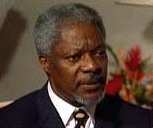 UN Secretary-General Kofi Annan urged
the Sudanese government and the SPLA to return to the negotiating table and put
an end to the country's civil war. In a statement released by his office, Annan
called on the government and the SPLA "to build upon the progress made
towards bringing an end to devastating conflict in the Sudan".
UN Secretary-General Kofi Annan urged
the Sudanese government and the SPLA to return to the negotiating table and put
an end to the country's civil war. In a statement released by his office, Annan
called on the government and the SPLA "to build upon the progress made
towards bringing an end to devastating conflict in the Sudan".
5: Trade
union members, students, mothers of slain soldiers and troops calling for jihad
marched through Khartoum's capital in a show of support for their government as
it steps up its battle against the SPLA. Torit town recently captured by the
SPLA "will return to the homeland virgin and will not be desecrated by the
rebels," President Bashir told the crowd estimated at 50,000 after the
march ended at the gates of army headquarters.
5: The SPLA was supported by an unidentified
neighbouring country in its capture of the government held town of Torit, a
Sudanese newspaper reported. A Sudanese military expert, said to be a
lieutenant general, told the Arabic daily Al-Shareh Al-Siasi that the
deployment of the SPLA fighters and the manner in which they were able to take
over Torit showed that they had about 9,000 men. "The SPLA forces in the
area are less than 5,000 men," he added.
5: Arab
foreign ministers formed a special committee to boost fragile peace efforts in
Sudan, notably to ensure the war-torn country does not break into pieces, an
Arab League source said. The nine-member committee will include representatives
from Sudan, Egypt, Libya, Syria, Saudi Arabia, Oman, and three as yet unnamed
countries, and will hold its first meeting in Khartoum before the end of the
year, the source said.
5: Khartoum
is committed to resuming landmark peace talks it walked out of last week,
Kenyan President Daniel arap Moi said after meeting Sudan's chief government
negotiator. Mohammed Idriss said "the government of Sudan was committed to
the resumption of talks which broke off recently following heavy fighting in
Southern Sudan," according to an official Kenyan presidential press
statement sent to AFP.
5: The
US Congress looks set to approve legislation that would impose sanctions
against the government of Sudan unless a firm peace agreement is reached with
the SPLA over the next six months.  But supporters of the bill, known as
the Sudan Peace Act, have agreed to drop a controversial provision that would
have prevented foreign oil companies that operate in Sudan from raising funds
in US capital markets.
But supporters of the bill, known as
the Sudan Peace Act, have agreed to drop a controversial provision that would
have prevented foreign oil companies that operate in Sudan from raising funds
in US capital markets.
6: Sudanese
security sources have denied as baseless a claim by the SPLA that it had downed
an army helicopter in southern Sudan, a newspaper reported. "The report by
the rebel movement that it shot down an army helicopter gunship in Unity State
is absolutely untrue," independent Akhbar Al Youm daily quoted unnamed
security sources as saying.
6: The international community has failed to
capitalise on a landmark ceasefire deal in Sudan's Nuba Mountains, and should
send more aid money to boost humanitarian conditions there, the body monitoring
the truce said. Results of the territorially limited ceasefire struck in
January between Khartoum and the SPLA "are more than positive. The
ceasefire is holding," Jean-Philippe Cevey, spokesman for the Joint
Military Commission (JMC), told AFP in Nairobi.
6: Contacts are under way to resume peace talks
between the government of Sudan and the SPLA, broken off on September 2, the
official news agency SUNA quoted a US diplomat as saying. US charge d'affaires
in Khartoum, Jeff Millington, told SUNA the contacts were held between the
Sudanese government and Kenya, the nation hosting the talks.
7: President
Bashir has expressed support for Iraq in the face of US war threats, an envoy
of Iraqi President Saddam Hussein who met him told the official SUNA news
agency. Bashir praised Iraq's "steadfastness throughout the past
years" and stressed that Iraq "will certainly gain victory over the
conspiracies and plots," said the envoy, Iraqi Culture Minister Hamed
Yussef Hammadi.
7: Sudan
criticized the UN for withdrawing its employees from the southern town of Juba
amid fears the SPLA will attack the government-held stronghold. Sulaful-Deen
Salih, head of the government's Humanitarian Aid Commission, accused the world
body of asking its employees to leave Juba, southern Sudan's biggest town after
a rebel warning that they would attack it after recently capturing the nearby
city of Torit.
7: Sudan
has said it will resume landmark peace talks with the SPLA to halt the war if
they meet certain demands, a Sudanese newspaper said, but rebels said they
would not accept any preconditions. "The government has laid three
conditions for the resumption of dialogue with the rebel movement," al-Rai
al-Aam newspaper said, quoting an unnamed "highly placed diplomatic
source". "They are: ending military escalation by the rebels,
returning the situation to what it was before the seizure of Torit and stopping
rebel movement meant to capture new areas."
8: The government sent another battalion
of Islamist militiamen to southern Sudan as part of a military mobilisation
aimed at recapturing Torit from the SPLA. The government staged a ceremony for
the departure of a battalion of more than 100 mujahedeen (holy warriors), all volunteers
from the Popular Police Force, from Khartoum airport to Juba, some 120 km east
of Torit.
8: The
Sudanese government is sending envoys to Arab, African and Asian capitals to
explain its position on peace efforts with the SPLA after suspending negotiations
last week, a paper reported. President Bashir sent emissaries to neighbouring
Chad and Libya, Nigeria, Arab allies Syria and Saudi Arabia, and China, whose
state China National Petroleum Corp (CNPC) is a leading player in Sudanese oil
drilling, the independent al-Rai al-Aam said.
8: The
SPLA said it was ready to riposte any government attempt to recapture Torit.
"We are ready for them," said Samson Kwaje, the Nairobi-based
spokesman of the SPLA. "We will be waiting for them on the Juba-Torit
road," he told AFP referring to the road linking the southern city of Juba
with the Torit, some 120 kilometres to the east.
9: The
SPLA has denied recent media reports that it is intending to attack and seize
Juba - the largest city in southern Sudan's Equatoria region - from the
government. SPLA spokesman Samson Kwaje told IRIN on Monday his group had no
plans to attack Juba, and was instead concentrating on the defence of Torit.
9: Khartoum
will only resume peace talks with southern rebels if they halt attacks and
withdraw a demand to renegotiate some issues, government officials said. First
Vice President Ali Osman Taha told Al-Anbaa daily that "negotiation is
meaningless so long as the war is going on."
10: President
Bashir vowed to "impose" peace in Sudan despite a recent offensive by
the SPLA SUNA news agency reported. "Peace is coming, despite... the
rebels, agents and traitors," Bashir said while inaugurating a plant
producing tanks, armored vehicles, other military equipment and agricultural machinery
in Giad industrial city, 45 kilometres southeast of Khartoum. "We
manufacture weapons and arm ourselves, not for war but for imposing
peace," said Bashir.
10: An SPLA official said that his movement was ready to put a ceasefire top of the agenda if the Khartoum government agrees to return to suspended peace talks. However, the reported proposal by Arek Machar of the SPLA was immediately shot down as "insufficient" by Sudanese Foreign Minister Mustafa Osman Ismail.
11: Sudan expressed its condolences to the
United States on the anniversary of the September 11 attacks, calling for a
UN-coordinated cooperation to fight terrorism, Sudan TV reported. A statement
from the foreign ministry described the attacks as "regrettable
terroristic incidents in which thousands of innocent people were killed.
"While reckoning this painful anniversary, we are aware that we are in bad
need for consolidating international cooperation and for laying down principles
and arrangements for fighting and uprooting international terrorism, " it
added.
11: Talisman reiterated that its Sudanese
assets remain for sale, contrary to previous reports that negotiations had been
completed with India's state-owned Oil & Natural Gas Corp. Edward Bogle,
Talisman's vice-president of exploration, told reporters after an energy
conference in Toronto that Talisman doesn't yet have a public offer to
announce, but has had numerous expressions of interest.
13: Sudan's ambassador in Egypt, Ahmed
Abdul Haleem, charged Israel of arming and training the SPLA. "The Israeli
role has become much more active recently in southern Sudan," the diplomat
told the Egyptian official MENA news agency. "This role consists not only
in arming and training" the rebels, but "it also seeks to complicate
the situation by causing sedition between the sons of the same people," he
said.
14: The Sudanese government denied that the
United States had offered to lift sanctions if Khartoum agreed on resuming
peace talks with the SPLA. "The United States has not put forward such an
offer to the government," State Foreign Minister Chul Deng told
journalists.
Part II- Northern Uganda
briefs
War Against the Peacemakers in Northern Uganda
By Linda Frommer
Despite the continuing military offensive of the Ugandan People's Defense
Forces (UPDF) in northern Uganda against the Lord's Resistance Army (LRA) of
Joseph Kony, the LRA continues to target both military and civilians, and
school-age children for recruitment. All the while, 5,000 UPDF soldiers remain
in southern Sudan, although the LRA is increasingly active within northern
Uganda itself.
The peace negotiations
between the LRA and the Acholi Religious Leaders Peace Initiative that begun in
the second week of August were virtually halted when President Yoweri Museveni
turned down a ceasefire offer from the rebels and placed conditions on a
ceasefire, which includes the rebels gathering at demilitarised areas,
presumably for surrender. This was the same condition that led to the halt to
the peace process in 1994. At the end of the month, the UPDF attacked a meeting
of three Catholic priests with the LRA, hoping to capture the LRA commander who
had been slated to attend. The commander did not attend, but the UPDF arrested
and detained the priests, for hours without water, until they were released
from Gulu the next day (see below).
That very day, Museveni had
excoriated a call for peace issued by one of the detained priests, Father
Carlos Rodriguez. On Aug. 14, the LRA abducted two Italian missionaries who
have been working on northern Uganda. It appears that without strong
international pressure, particularly from the United States, Great Britain, and
other donors to Uganda, negotiations will not proceed between the LRA and the
government, despite the fact that the Acholi religious, community, traditional,
and political leaders are united in their call for such negotiations to end the
war as swiftly as possible. The World Food Program has warned that if the
internally displaced people in northern Uganda, whose number has grown by
100,000 to 536,000 in the last two months, are not able to return home in the
next three weeks and plant crops, the northern region will face famine in the
months ahead.
August 15: LRA
crosses into Pajule and fights with the UPDF, abducting three people who are
later released. LRA approach Acholibur trading centre in the late morning. UPDF
gathers on the other side of the centre and starts bombing it as people
scramble to leave. At least one pregnant woman is killed. LRA abducts 20 people
near Pajule at night and five pupils from Lukome Parish.
16: UPDF and LRA clash at Kitgum Matidi trading centre. Four LRA are
killed, all of who, witnesses said, were under 14.
17: LRA attacks shop on outskirts of Kitgum town.
18: LRA attacks Lukole trading centre at mid-day looting shops, burning
huts, and taking people.
19: Canadian Physicians for Aid and Relief (CPAR) calls for aid for
northern Uganda population. Speaking of the LRA attacks on the civilians in
northern Uganda, CPAR country director for Uganda, Gizaw Shibru, says, "If
emergency aid is not provided immediately, many thousands of innocent people
could die of starvation and disease very quickly."
19: Chief of Military Intelligence Col. Noble Mayombo tells the press he
has information linking Reform Agenda leader Col. Dr. Kizza Besigye to the LRA.
20: LRA attacks Acholippi, Omot Sub County, killing six men, one
schoolboy and one schoolgirl, and abducting eight people.
20: Archbishop Odama and Bishop Ochola of the Church of Uganda meet with
two leaders of the LRA, as part of peace negotiations and are given a letter to
deliver to President Museveni from the LRA. The letter was the result of peace
negotiations, between the LRA and the Acholi Religious Leaders Peace
Initiative, of which Archbishop Odama is chairman. The minutes of the meeting
were released by ARPLI and printed in The Monitor on Aug. 14.
21: Archbishop Odama delivers a letter from LRA commander Joseph Kony to
President Museveni in Gulu.
23: President Museveni names peace team for negotiations with Joseph
Kony and the LRA. The team comprises of First Deputy Prime Minister and
Minister of Internal Affairs Eriya Kategaya, who will head the team, Lt. Gen.
Salim Saleh, Members of Parliament Regan Okumu and Norbert Mao (both from Gulu
district), Education Minister Betty Akech, Presidential Minister Gilbert
Bukenya, and Attorney General Francis Ayume. Museveni reportedly proposes to
the LRA a one-week ceasefire to give the rebels the possibility to collect in
demilitarised areas, with the LRA in return desisting from all abductions and
incursions against civilians.
23: House of Bishops of Uganda, sitting at the Uganda Christian
University, calls for ceasefire between the government and the LRA.
24: LRA commander Kony kills eight of his own fighters in southern Sudan,
for allegedly planning to defect to the Government.
25: MP from Aswa Reagan Okumu says that the LRA contacted him and said
they were declaring a ceasefire and wanted the team of mediators expanded.
"The rebels are serious on their ceasefire. They want the mediators to
meet them quickly to prepare to communicate to President Museveni. They want to
know when and where the talks should take place," Okumu said.
26: LRA kills two travellers in an ambush at Kaladima village Lamogi Sub
County in Kilak County, west of Gulu. Twelve people sustained serious injuries
in the attack and were hospitalised.
26: Defense Minister Amana Mbabazi tells Parliament that some
politicians and NGOs are backing the LRA. He further states: "The LRA has
been denied the capacity to attack the Ugandan People's Defense Forces (UPDF)
defence. That is why it has resorted to wreaking havoc on civilian targets,
especially the internally displaced people's camps. This will also fail since
the UPDF has deployed and continues to deploy to protect the camps."
26: The UPDF rejects the unilateral ceasefire declared by the LRA,
because the LRA has not met conditions. Army spokesman Major Shaban Bantariza
says he has orders from the acting army commander, Maj. Gen. James Kazini, not
to cease-fire. "We are continuing to fight or hunt them. The army expects
the rebels to follow the conditions President Museveni gave them and assemble
in the places mentioned before a ceasefire can be declared."
26: Article by Fr. Carlos Rodrigues of the Acholi Religious Leaders
Peace Initiative appears in the press, calling for peace negotiations to end
the war. "As long as Ugandans continue to die in this war, there is no
success, whether the victims are LRA rebels, UPDF soldiers or civilians. Nobody
is winning this war, we are all losers. The real experts in the situation, the
people on the ground who have known deep suffering for the last 16 years, think
it is only peaceful negotiation that will end the violence in northern Uganda.
The press must step to their side and support this peace process so that boys
like Denis or the girls who stay at Pajule Mission [abducted children since
returned from the LRA and the bush and now rehabilitated], may in the future go
to school, and not to the grave. Nobody wins wars. Only peace will win this
one."
26: Government of Uganda demands the extradition of Reform Agenda leader
Dr. Kizza Besigye from South Africa, according to MISNA, on the basis of
charges that he is linked to the LRA.
27: LRA attacks Aloi Sub County in Lira district, abducting 50 people
and killing a four-month-old baby. Two LRA rebels surrender to the UPDF at
Negeta in Lira.
27: UPDF helicopter gunship kills civilians and injures many others in
air attack on Anara parish in Lira District.
28: UPDF ends peace offer to rebels. Maj. Shaban Bantariza declares an
all-out UPDF offensive against the LRA, because of the LRA refusal to accept
government conditions for a ceasefire. "They do not want to take any of
our conditions so they should not blame us for not offering a better
option," he said.
28: President Museveni issues response to statement of Father Carlos
Rodriguez, stating that "Father Carlos's arguments like most arguments of
pacifists are misleading and erroneous. I only agree with Fr. Carlos on one
point. It is a great tragedy that the so-called enemies we are killing are
actually children who were abducted by force. I am devoting more time to the
readying of the UPDF to deal decisively with all those who choose an
unconstitutional, terrorist, or criminal road. The people of Uganda deserve
peace and development. They will get both as a result of strengthening their
defence institutions that will guard their democratic institutions and their
constitutions. They will not get either or both by pandering to the whims of
criminal hoodlums like Kony, nor by listening to the exhortations of their
apologists like Fr. Carlos."
28: Fr. Carlos Rodrigues, a member of the Acholi Religious Leaders'
Peace Initiative in Gulu, is arrested by the UPDF, with Fr. Julius Albonere,
director of MISNA, and Fr. Tarciscio Paszania, of the Pajule Catholic mission
in Aruu county, Pader district. The UPDF attacked the priests as they were in a
meeting with three members of the LRA. UPDF claims the priests were carrying
large quantities of drugs. According to MISNA director Fr. Guilio Albanese, the
UPDF attacked the meeting. "Bullets, grenades, rockets and shots of every
kind: we remained face down on the ground for an endless hour under a shower of
fire. We thought we would die at any moment. We had started talking to the
rebels for about 20 minutes, we when we were plunged into what appeared to be
the end of the world. As soon as the battle ended, the Ugandan soldiers slapped
and beat us, accusing us of being arms dealers for Al Quaeda, incredible but
true." For 10 minutes, the UPDF soldiers held the priests face down on the
ground at machine-gun point. There was a wounded woman lying next to me, but
the soldiers threw her a couple meters away, leaving her there to die. This is
the treatment they normally reserve for civilians or rebels. They then decided
that they could take us along and forced us to walk around 20 kilometres: six
hours without food or a drop of water." After the long march, reports
MISNA, the three missionaries were stripped and thrown into a shed at the
military barracks of Kitgum. We were awake all night, locked in a shack without
water, food, or toilet facilities, but we prayed and gave each other
strength."
29: The three priests under the custody of the UPDF are flown by
helicopter gunship to army barracks in Gulu. They are released later that day.
The UPDF spokesman said: "There was no prior notification of the UPDF
regarding the movement of the three priests, to meet the rebels in that area as
has been the procedure, through Archbishop Odama. The priests were found with
drugs, dry cells (batteries), and documents intended to be delivered to the
rebels. The three Fathers signed the documents. The priests have been made to
make statements to the security and have today been released and warned not to
act in that manner again. The statement is correct and signed by them."
Father Carlos tells New Vision, however, that: "I was only with my two
colleagues in our pick-up. We neither carried rebels, nor guns, nor
communications gadgets. Father Tarcisio got permission from local officials in
Kitgum to take medicine to the rebel leaders were going to talk to but it was
removed from us by the UPDF at a road block. We also had dry cells for domestic
radios. We are very sorry that we did not inform the army in Gulu. We were
arrested after we had talked to the rebel leaders for 30 minutes. We had not
yet got their names. We are not rebel collaborators. We care for all. In Gulu
we were treated very well but not so well in Kitgum. But we forgive. We want to
live beyond this incident and realize peace in Uganda."
29: Reform Agenda of exiled Dr. Besigye releases a statement to press
from Dr. Besigye that "it is not the policy of the RA to take up arms to
fight against the illegitimate government of President Museveni. Neither am I
personally involved in the war as alleged by President Museveni and his
men." The RA was responding to a charge by the National Resistance
Movement Director of Information Ofwono Opondo that the Reform Movement was
part of the LRA. He claimed that the RA leaders are "in the war. One of
these days we shall get more evidence when they are captured or killed."
September 2: LRA attacks village of Kurku in Adjumani district, looting
shops and houses and abducting at least 50 people. "In cases like
this," a member of the civil society explains, "many of the civilians
are released a few hours later, after being used as porters, transporting the
stolen goods back to the rebel encampments. All of them are usually released except
for the children and youth, which are then trained by the LRA and used as
'child soldiers.'"
2: Two UPDF battalions leave the Democratic Republic of the Congo for
northern Uganda.
3: Archbishop Odama releases statement stating: "We remain
resolutely committed to the peace process and will continue with our efforts.
We urge the people of North Uganda and the country at large not to lose heart
but to continue supporting the efforts for peace." On the detention of the
three priests, the Archbishop affirmed "that every effort was made by the
priests to comply with previously agreed procedures and arrangements for
holding confidence building meetings with the LRA. We will continue to
cooperate with the Government of Uganda, the UPDF and all relevant authorities
in our efforts in the future. We do not hold this incidence against those who
arrested the priests, and we will not be deterred in our efforts by it."
3: President Museveni proposes that 3,000 children from northern Uganda
be relocated to southern or central parts of the country to avoid trauma
effects of war. Prime Minister Prof. Apolo Nsibambi says the President
"wants at least three schools in the south away from the area of stress so
that they can be given special attention."
3: MP Norbert Mao reports that LRA leader Kony has again written to
President Museveni expressing his willingness to hold peace talks with the
government. "The rebels have again written to the president even
suggesting that if the ceasefire cannot be agreed upon and respected, they are
ready to hold talks with the government outside Uganda."
3: LRA opens fire against a pick-up truck in Dore, about 10 kilometres
from Kitgum. At least three people were killed, and many were injured,
including women and children. According to MISNA, numerous UPDF forces were
deployed to Kitgum.
4: World Food Program Uganda director Ken Davies states that if the
536,000 internally displaced in northern Uganda are not able to "get out
to their land and plant for the next harvest within the next three weeks, they
will be at as great a risk of starvation as anyone in southern Africa."
4: First Deputy Prime Minister and Minister of Internal Affairs Eriya
Kategaya states that there is no reason for the government to support the
demand of MPs from the north that the three war districts of northern Uganda be
declared a disaster area.
4: UPDF brigade based in Paltaka 40 kilometres from the Uganda-Sudan
border clash with LRA fighters. Over 5,000 UPDF soldiers remain in southern
Sudan to fight the LRA.
4: UPDF and LRA battle takes place in Tumango west of Kitgum town,
killing four rebels and injuring one UDPF solider.
5: LRA intercepts a truck hired by the British NGO Accord to deliver
non-food relief supplies from Gulu to Kitgum. The LRA kills the driver of the truck
and burns it.
6: The LRA attacks a bus at Parajok, killing two people and injuring
three others. District Commissioner Peter Odok condemns the attack, saying that
"It is very unfortunate because we very well know that were the attack
took place is an area where we have patrols by the UPDF."
6: LRA kills two UPDF majors and their escorts in an ambush in Pader
district.
7: LRA carries out ambush killing 10 UPDF soldiers on the road that
connects Kampala with Lira. LRA carries out two other ambushes on the roads.
9: Health State Minister Mike Mukula says that 86 percent of the youth
in northern Uganda are suffering from STDs, including HIV/AIDS. "The high
rate of STDs and HIV/AIDS in the northern region has been fuelled by the Kony
war. It is high time we stopped the fighting and get peace to save the lives of
our population," he says. "Kony is a Ugandan, and his problem has
become a national affair. 75 percent of the rebel fighters are very young
children and the commanders are having up to 22 women who are young
children."
12: LRA attacks Sudanese refugee camp in Maaji in Adjumani District,
abducting 19 people.
12: LRA attacks a lorry on Pakwach Road, killing a number of UPDF
soldiers.
14: LRA attacks Okwang Sub County in Otuki County in Lira disrupting the
census exercises. LRA also reportedly killed 13 people in Aber sub country,
Apac.
14: LRA abducts two Italian missionaries, Father Alex Pizzi and Father
Ponziano Celluto, from the Catholic mission at Opit. Two LRA groups attack the
mission.
ENDS
Part III- Horn of Africa
briefs
August 16: The EU Council of Ministers has offered
financial and technical support to a "provisional, all-inclusive,
broad-based" government in Somalia, as successor to the Transitional
National Government. The support would, however, be conditional on a number of
requirements, including the functioning of the main infrastructures in the
country, such as the port and airport in the capital Mogadishu, the free
circulation of people and goods, the launching of a partnership with the
country's various regions, and the establishment of harmonious relations with
neighbouring countries, a statement from the Council said.
21: At least 90 government officials
of the Southern Nations, Nationalities and Peoples' State (SNNPS) in Ethiopia
have been arrested by the state authorities in the Sheko Zone for involvement
in human rights violations and abuse of office, a member of the Investigation
and Peace Restoration Committee of the SNNPS told IRIN. The zone was rocked by
ethnic clashes between the indigenous Sheko-Mezhenger and settler ethnic
communities in March, in which over 100 people were killed.
26: A meeting of the foreign ministers of Djibouti,
Ethiopia and Kenya to discuss the Somali peace process has again been
postponed. The meeting was originally fixed for 16 August, then postponed until
last Friday (23 August) and further delayed until this week.
September 9: The authorities in the self-declared republic of
Somaliland will not attend the upcoming Somali reconciliation talks, Somaliland's
Information Minister Abdullahi Muhammad Du'ale told IRIN. He said it was well
known that the government's policy was not to participate in such conferences.
Du'ale said that IGAD - under whose auspices the talks will be held - was aware
of Somaliland's policy on this issue.
10: The president of the self-declared South West
State of Somalia, Col Hasan Muhammad Nur Shatigadud - who is also the chairman
of the Rahanweyn Resistance Army (RRA)- has met one of his rival deputies in
Ethiopia, an RRA source confirmed to IRIN. Speaking from Baidoa, Shatigadud's
stronghold, the source added that the RRA chairman also met Ethiopian
officials.
11: The much-postponed Somali reconciliation
conference, brokered by the regional Inter-Governmental Authority on Development
(IGAD), has been rescheduled to convene on 15 October in the western Kenyan
town of Eldoret, a Kenyan foreign ministry official told IRIN.
"It is now agreed that the conference will take place no later than 15
October," said the Kenyan official. Delegates were expected to arrive on
12 October for registration.
ENDS