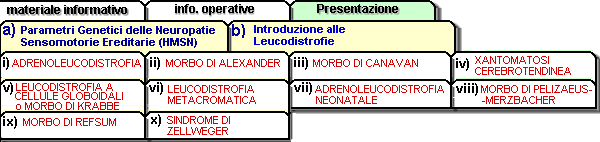
c) Parametri clinici e storiografia terapeutica delle leucodistrofie
i) ADRENOLEUCODISTROFIA
(ADRENOLEUKODYSTROPHY)

DEFINITION:
  incidence: 1/100,000
   age of onset:
      4 to 8 years of age
   risk factors:
      familial - x-linked recessive
         chrom. #: Xq28 (terminal segment)
         gene: ? lignoceroyl-CoA ligase (peroxisomal enzyme)
PATHOGENESIS/PATHOLOGY:
 1. Peroxisomes

   1. Structure

      intracellular organelles present in all cells except
      mature erythrocytes, especially in those that specializein
      lipid metabolism abundant in:
        neurons during the first two postnatal weeks
        oligodendroglial processes forming myelin shealths during
        active myelination

      2. Function

      contain enzymes (40) necessary for cellular metabolism
      enzymes catalyzing the beta-oxidation of VLCFA
      enzymes catalyzing the synthesis of plasmalogen
      decomposition of hydrogen peroxide (catalase)

   2. X-linked Adrenoleudodystrophy

      considered to be a disorder of lipid metabolism and particularly the
      peroxisomes; alsoconsidered a storage disorder
      deficiency in the peroxisomal enzyme that catalyzes the formation
      of Co-A derivatives of VLCFA (lignoceroyl-CoA ligase) results in the
      accumulation of saturated, unbranched VLCFA in the rER of tissues
      throughout the body, particularly hexacosanoic (C26:0),
      pentacosanoic (C25:0), tetracosanoic (C24:0)
      the genetic defect may not be due to a mutant ligase gene but instead
      due to adeficiency in a peroxisomal membrane protein needed to import
      the ligase into the peroxisome (ATP-binding transporter protein)
      particularly affected is the:

       1. Adrenal Cortex

         zona fasciculata distended with abnormal lipids accumulation of
         VLCFA results in:
            limited capacity to convert cholesterol -> active steroids
            increased viscosity of the plasma membrane -> receptor
            dysfunction

       2. CNS White Matter

         acute and symmetric demyelinating lesions
         perivascular infiltration of lymphocytes
         at least 1/3 of patients with ALD are free of neurol.
         manifestations
         and thus CNS involvement may depend upon some factor other than
         VLCFA
         accumulation considered one of the degenerative diseases of white
         matter of the cerebral cortex
CLINICAL FEATURES:
   1. Male Phenotypes (6)

      48% - Childhood ALD
      26% - Adrenomyeloneuropathy
      10% - Addison Disease Only
      8% - Presymptomatic/Asymptomatic
      5% - Adolescent Cerebral ALD
      3% - Adult Cerebral ALD

   2. Female Phenotypes (2)

      85-95% - Asymptomatic
      10-15% - Adrenomyeloneuropathy - late onset, less severe

   3. Childhood ALD

      age of onset: 4-8 years (mean = 7.2 years, as early as 2 years)
      affected children develop normally up until 3-4 years of age

      1. Neurologic Manifestations

         1. Presenting Symptoms

            hyperactivity (most common)
            impaired auditory discrimination - difficulties with speech
            in a noisy room or over the telephone (retain pure tone
            perception)
            parietal lobe dysfunction - construction & dressing apraxia,
              astereognosis, graphesthesia, impaired spatial orientation
            visual disturbances - field cuts, strabismus, visual acuity
              focal or generalized seizures (33%)
            others: ataxia, poor handwriting, subtle changes in affect,
            behaviour, & attention span, increased ICP, dementia

         2. Later Symptoms

            tends to progress rapidly with increased spasticity and
            paralysis, visual and hearing loss, and bulbar musculature
            dysfunction (loss of ability to speak +/- swallow), cognitive
            loss -> vegetative state
            mean interval between onset of neurologic symptoms and the
            vegetative state is 1.9 +/- 2 years
            may continue in vegetative state for >10 years

   2. Endocrine Manifestations

      primary adrenal insufficiency
      FTT, nausea & vomiting, postural hypotension, weakness,
      weight loss, salt craving mild hyperpigmentation (over joints,
      scar tissue, lips, nipples, buccal mucosa) usually present
     after the neurologic manifestations

4. Adolescent Cerebral ALD

   age of onset: 10-21 years
   the neurologic and endocrine manifestations are the same
   as in the childhood cerebral ALD form except with a slower
   progression

5. Adrenomyeloneuropathy

   age of onset: late adolescence or adulthood

   1. Neurologic Manifestations

      progressive spastic paraparesis and sphincter disturbance
      due to long-tract degeneration in the spinal cord and
      peripheral nervous system
      33% have CNS white matter involvement
      10-15% of female heterozygotes (carriers) develop neurologic
      disturbances resembling adrenomyeloneuropathy
      progressive loss over 5-15 years without cognitive loss

   2. Endocrine Manifestations

      90% have varying degrees of adrenal insufficiency
INVESTIGATIONS:
   1. Serum

      1. VLCFA

         very high levels of VLCFA in the plasma, RBC, and
         cultured skin
         fibroblasts is diagnositic:
         positive in 100% of affected males
         positive in 85% of carrier females
         high levels of C26
         abnormal ratio of C26:C22 and C24:C22 fatty acids
         15% of obligate carriers will test within the normal range

      2. Adrenal Insufficiency

         hyponatremia, hyperkalemia, mild metabolic acidosis
         low serum cortisol level with elevated ACTH levels
         impaired cortisol response to ACTH stimulation in 85%

   2. Imaging Studies - CT/MRI

      1. Cerebral White Matter Lesions (80%)

         even in the early stages, striking changes may be found
         characteristic with two types of features:
         low-attenuation lesions
         represent symmetrical areas of degeneration or
         demyelination involve the periventricular white matter in
         the posterior parietal and occipital lobes (peritrigonal)
         also involved are the corticospinal tracts, corpus callosum,
         medial/lateral geniculate bodies, thalamus
         in 12% the initial lesions are in the frontal lobes
         affected white matter may also be calcified
         high-attenuation lesions
         zones of intense perivascular lymphocytic infiltration where
         the blood-brain barrier breaks down

      3. Perinatal Diagnosis

         elevated VLCFA in cultured amniocytes or chorionic villus
         cells carrier identification
         VLCFA assay identifies 85% of carrier females
         DXS-52 polymorphic DNA probe
MANAGEMENT:
      1. Adrenal Insufficiency

         1. Steroid Replacement

            oral glucocorticoid (cortisone acetate)
            oral mineralocorticoid (fludrocortisone)
            increase at times of illness, trauma, surgery
            does not tend to influence the course of the disease
            test adrenal function regularly i.e., yearly

  2. Neurologic Manifestations

     1. Behavioural

      comprehensive management programme, special education

      2. Medical

       beclofen for acute episodes of painful muscle spasms
       anticonvulsants for seizure activity
       chloral hydrate for changes in sleep-wake cycle
       soft diet -> pureed foods -> gastrostomy for loss of bulbar
       muscular control

      3. Diet

          1. Goals

            to decrease the exogenous source of VLCFA - food
            sources of  fats, cholesterol,grains, nuts, fruits and
            vegetable skins, milk -> very restrictive diet
            to decrease the endogenous production of VLCFA with
            the ingestion of monounsaturated VLCFA's

            2. Glyceryl Trierucate Oil (GTO)

               90% oleic acid (C18:1) found naturally in olive oil,
               corn oil, sunflower seed oil
               ingestion results in a decrease in VLCFA's by 50% in
               4 months

            3. Glyceryl Trioleate Oil (GTE)

               erucic acid (C22:1) - found naturally in rapseed oil

            4. Lorenzo's Oil

               4 parts GTO: 1 part GTE
               VLCFA-restricted diet with Lorenzo's Oil may normalize
               C26:0 levels within 4weeks
               normalizes RBC membrane microviscosity

         4. Bone Marrow Transplant

            experimental
            poor results in severe cases and mild results in those
            less severely affected