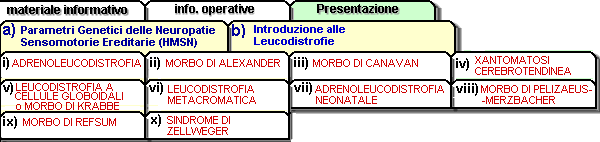
a) Parametri Genetici delle Neuropatie Sensomotorie Ereditarie (HMSN)

Andermann syndrome
Cowchock
Dejerine-Sottas
Focally folded myelin sheaths
HMSN: Complex
HMSN: Demyelinating
   Dominant: IA; IB; HNPP; III
   Recessive: III; 4A; 4B; ?4C
   X-linked
HMSN: Axonal
   Dominant: II; IIA; IIB; IIC; IID; 5; 6
   X-linked
HMSN: Types
Liability to pressure palsies
Other: Myelin disorders; Recessive
        Cockayne's
        Congenital hypomyelinating neuropathy
        Krabbe
        Metachromatic leukodystrophy
        Refsum's disease
Other: Childhood onset
1. HMSN IA
         PMP 22; Chromosome 17p11.2-p12; dominant
          Duplication (3 copies)

   Clinical-genetic correlations
      Chromosomal duplication containing PMP-22 is identical to region
      deleted
      in HNPP
      Homozygotic twins: Similar NCV but often dissimilar clinical severity
      "Sporadic" cases
         Usually have duplications of paternal origin.
            Due to unequal crossing over of homologous Chromosome 17s
            'Mariner' insect transposon-like element (MITE) near break site
               ? Promotes DNA cleavage by transposase
               ? Cleavage leads to unequal cross-over
         Rare maternal origin: Due to intrachromosomal rearrangement
   Clinical features
      Distal weakness in feet & hands
      Mild sensory loss
      Hypo- or areflexia
      Onset: Teens to 30's
   Electrophysiology
      Demyelinating Neuropathy
         NCV: Uniformly slow; No conduction block
         NCV slow before clinical signs appear
   Pathology: Early excess myelin production
      Onion bulbs
         Small to moderate size & frequency
         Many develop > 6 y.o.
      Myelin sheaths thicker than normal

          Point mutation, intramembrane domain

   Clinical features: More severe than duplication
   Electrophysiology
      Demyelinating Neuropathy: More severe than duplication
   Pathology: Early reduced myelin production
      Onion bulbs
         Large & on most axons
         Most develop < 6 y.o.
      Myelin sheaths thinner than normal

          Homozygotes
           PMP-22 duplication (4 copies); Chromosome 17p11.2-p12

   Clinical features
      Most severe weakness
      Earlier onset < 1 year
   Electrophysiology: Very slow NCV

          Autosomal Recessive
           PMP-22 point mutation - Thr118Met; Chromosome 17, and
           PMP-22 deletion

   Clinical features: Severe phenotype

2. HMSN IB
         P0 protein ; Chromosome 1; Dominant

   Genetic features
      Mostly point mutations
      Exons 2 & 3 most common
         Corresponds to immunoglobulin-like extracellular domain
      2 mutations in exon 4: Margins of transmembrane domain
      1 mutation in transmembrane domain
         Pathology with severely hypomyelinated axons
   Clinical features
      Distal > proximal weakness; Sensory loss
      Areflexia
      Onset
         Often in 1st decade: Delayed walking
      Progression: Severe disability in some by 20 to 40 years
      Nerves not usually clinically enlarged
      Electrophysiology: Marked slowing of NCV < 20 M/s
   Pathology: Demyelinating; 2 types depending on site of mutation
      Uncompacted myelin
         23% to 68% of myelinated fibers
         Fewer demyelinated axons
         Mutations in amino acids 5, 34 & 69
         ? mutations interfere with homophilic adhesion function of P0
      Focally folded myelin
         Mutations in amino acids 101 & 106
         Also seen in type 4B
   Other P0 gene-defect syndromes
      Dejerine-Sottas phenotype
      Congenital hypomyelinating neuropathy

3. HMSN: X-linked

   Type 1; semidominant
           Connexin-32; Chromosome Xq13.1; Semi-dominant
      Clinical features
         Motor: Hand & foot weakness
         Sensory: Early proprioceptive loss
         Reflexes: Absent distal; preserved elsewhere
         Different phenotypes
                    Mild or moderate: Missense point mutation
               Mixed Neuropathy (NCV: Intermediate (35-40 M/s))
                    Severe: Out of frame deletion or insertion
               Demyelinating Neuropathy (NCV: Slow (10-37 M/s))
                    Females: Heterozygotes
               Mild signs & less demyelination, or
               Asymptomatic carriers
   Cowchock Syndrome: with mental retardation and deafness
           Chromosome Xq22
      ?allelic with connexin syndrome
   Type 2; Recessive
           Chromosome Xp22.2
      Onset 1st decade
      Distal weakness
   Type 3; Recessive
           Chromosome Xq26
      Onset end of 1st decade
      Distal weakness

4. HMSN II: Axonal Neuropathy (NCV: Axonal Loss)

   IIA
           Chromosome 1p36; Dominant
      Clinical features
         Moderate Phenotype
         Upper & lower extremities involved
         Distal weakness, sensory & tendon reflex loss
         Tunisian families
   IIB
           Chromosome 3q; Dominant
      Clinical features
         Onset: 2nd decade
         Distal & symmetric sensory loss & weakness
         Lower limbs > upper
         Acromutilation & foot ulcers
         Phenotype variable in family: Severe in some, Mild in others
      Electrodiagnostic
         Axonal loss with absent sural potentials
         Preserved tibial H-reflexes
   IIC
           Autosomal Dominant
      Clinical features
         Diaphragm & vocal cord paralysis
         Distal weakness
         Depressed tendon reflexes
      Electrodiagnostic: Median NCV > 50 M/s
   IID
           Chromosome 7p; Dominant
      Clinical features
         Onset: 16 to 30 years
         Weakness: Distal; Arms & Legs
         Sensory loss: Distal; Arms & Legs; Pansensory
         Tendon reflexes: Absent arms; Decreased legs
         Progression: slow over years
      Electrodiagnostic: Axonal loss; Normal NCV
   Other: Rule out HMSN X-linked

5. HMSN III (Dejerine-Sottas): Severe, infant onset, non-progressive

   3 genetic types
           PMP-22 point mutations, intramembrane domain
           Chromosome 17; dominant

           P0 point mutation
           Chromosome 1q22; Recessive

           Chromosome 8q23-q24; Dominant
   Clinical features
      Weakness: Diffuse; Distal > Proximal
      Onset: Infancy
      Progression: Minimal
      Demyelinating Neuropathy (NCV: Very Slow (< 12 M/s))

6. Hereditary Liability to Pressure Palsies (HNPP)
         PMP-22 deletion; Chromosome 17p11.2-p12; Dominant
          Chromosomal deletion containing PMP-22 is identical to region
duplicated in HMSN IA

   Clinical - Genetic Correlations
      Variable penetrance
      37% of patients with gene deletion have no family history
      "Sporadic" cases often have deletions of paternal origin.
         Due to unequal crossing over of homologous Chromosome 17s
         Rare maternal origin: Due to intrachromosomal rearrangement

         Clinical features

   Onset
      Mean: 26 years
      Range: 8 to 64 years
      Some patients asymptomatic
   Nerve pareses with acute onset
   1 to 10 episodes, usually painless
      Prodrome
         After mild trauma or compression in 40%
         Repeated local exercise
         On awakening 10%
      Recovery: Complete 50%; Severe long term motor defecit 9%
   Neuropathy distribution
      Often asymmetric
      Pressure-related lesions in 62%
      Focal signs at usual sites of nerve compression
         Radial: spiral groove of humerus
         Ulnar: elbow
         Median: wrist
         Peroneal: head of fibula
         Brachial plexopathy: not painful vs. Hereditary neuralgic
         amyotrophy (HNA)
      Focal signs & sensory loss at unusual sites of compression
      Progressive generalized sensory-motor neuropathy
         May occur without pressure palsies
      Normal tendon reflexes in 62%
   Diagnoses in patients with multifocal neuropathies without a deletion
      Recurrent neuralgic amyotrophy
      Multiple lesions at common entrapment sites
      Patchy axonal neuropathy
   NCV
      Mild Slowing; Prolonged Distal Latencies
      Worse changes @ common entrapment sites
      Asymptomatic carriers abnormal even in childhood
         Prolonged distal motor latency: median or peroneal
         Slow NCV: Sensory or peroneal
   Pathology
      Focal thickening of myelin sheath: Tomaculae

7. HMSN 4A
         Chromosome 8q; Recessive

   Childhood Onset; Tunisian
   Demyelinating Neuropathy

8. HMSN with focally folded myelin sheaths  (HMSN 4B )
         Chromosome 11q23; Recessive

   Clinical features
      Onset: 2 to 4 years
      Weakness
         Distal & proximal
         Symmetric
         Progressive: Adults often wheelchair bound
         Facial: some with synkinesis
      Pansensory loss
      Tendon reflexes: Absent
      Pes equinovarus
      Prominent thick lips
   Electrophysiology: Demyelination; Myelinated axon loss
   Pathology: Irregular folding & redundant loops of myelin; Myelinated
   axon loss

9. HMSN ?4C
         Chromosome 5q23-q33; Recessive

   Demyelinating neuropathy

10. Andermann Syndrome: Peripheral Neuropathy & Agenesis of
      Corpus Callosum
      Chromosome 15q13-q15; Recessive

   Clinical Features
      Sensory Motor Neur(on)opathy - Severe
      Areflexia
      Progressive weakness
      Mental retardation; Atypical psychosis
      Seizures; Optic atrophy
      Face
         Long; Hypertelorism
         Diplegia; Ptosis
      French-Canadian: Charlevoix-Saguenay geographical focus
      Electrodiagnostic: Axonal loss; Absent sensory potentials
      Agenesis of corpus callosum: Partial or complete (58%)
      Pathology: Axonal swellings with few neurofilaments

11. HMSN with pyramidal features (HMSN 5)
         Autosomal Dominant

   Weakness: Distal; Legs > Arms
   Extensor plantar responses; No spasticity
   Onset: < 20 years
   Electrophysiology: Axonal loss

12. Complex HMSN (HMSN 6)

   Optic atrophy, retinopathy, deafness
           Autosomal Dominant
      Clinical features
         Severe visual loss
            Onset age 7 to 10
            To light perception only by age 30
            Red-Green dyschromatopsia
            Other dominant optic atrophies: Blue-Yellow defects
         Asymptomatic sensory neuropathy
            Distal sensory loss
            Reduced tendon reflexes
         Electrodiagnostic: Axonal Sensory-motor neuropathy
   Optic atrophy & neuropathy
           Autosomal Dominant
   Also Recessive & X-linked forms with optic neuropathy 1 hearing loss

13. Metachromatic Leukodystrophy
         Arylsulfatase A; Chromosome 22q13.31; Recessive

   Clinical features
      Mental retardation; Optic Atrophy; Spasticity; Polyneuropathy
      Juvenile onset forms may present with polyneuropathy
      High CSF protein
      Demyelinating Neuropathy (NCV: Slow)
      Pathology
         Metachromatic inclusions in Schwann cells and macrophages
         Lamellar or dark ultrastructure
   Rule out:
      Multiple Sulfatase Deficiency (Recessive)
      Activator Protein (Prosaposin) Deficiency
              Chromosome 10q21-q22; Recessive

14. Galactosylceramide Lipoidosis (Krabbe)

   Chromosome 14q31; Recessive

   Mental retardation; Optic Atrophy; Spasticity; Polyneuropathy
   High CSF Protein
   Demyelinating Neuropathy (NCV: Slow)

15. Refsum's Disease

   Childhood onset (< 20 yrs): Classic form
           Phytanic Acid Oxidase ; Recessive
      Retinitis Pigmentosa
      Demyelinating Neuropathy
         Course may be Progressive or Relapsing
         High CSF Protein
      Anosmia; deafness
      Cardiac Failure (may cause sudden death)
      Less common: Ataxia, Ichthyosis
      Biochemistry
         Elevated serum phytanic acid
         Reduced oxidation of phytanic acid in fibroblasts
      Treatment with low phytanic acid diet
   Infantile onset
           ?peroxisomal disorder; Autosomal recessive
      Mental retardation
      Demyelinationg neuropathy
      Deafness
      Retinitis pigmentosa
      Biochemistry
         Hepatomegaly; steatorrhea
         Hypocholesterolemia
         Accumulation of phytanic acid, pipecolic acid, very long chain
         fatty acids Adult onset with increased pipecolicacidemia ;
   ? peroxisomal disorder; Chromosome 10p; Recessive